Intelligence per megawatt


While the cost of machine intelligence is falling faster than that of any transformative technology before it, that alone does not make it sustainable. I've drafted five commitments for building AI that I believe will leave the next generation better off.
The ACT chapter of the Sustainable Engineering Society (SENG) - a technical society of Engineers Australia - asked me to join a roundtable on balancing AI growth with sustainability.
SENG's members are engineers and other professionals working on sustainability - I build AI software, so before I sat down, I spent a bit of time thinking about sustainability in the context of AI. That began with wanting to understand the problem space a bit better by asking how much intelligence do we get per megawatt, and is it improving?
Well, the answer is promising: it is improving, and faster than any comparable technology ever has - but that might be the least useful part of what I discovered.
The price of thought
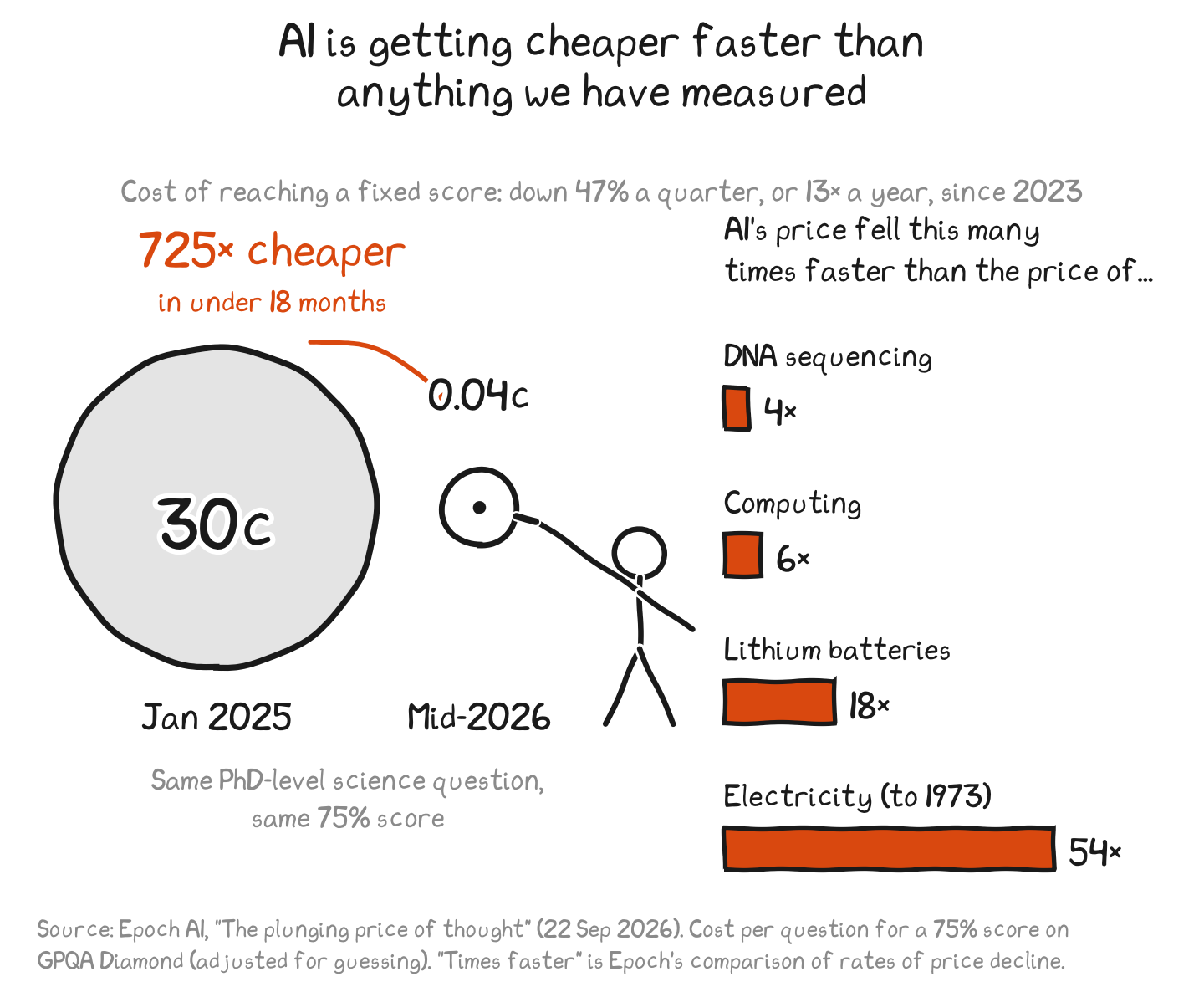
Epoch AI measures what it costs to reach a fixed score on hard benchmarks in maths, science and chess. Since 2023 that cost has fallen about 47% a quarter, or 13 times a year.
In January 2025, a 75% score on GPQA Diamond (an exam in PhD-level science, adjusted for guessing) cost about 30 cents a question. Less than 18 months later it cost four hundredths of a cent: a 725-fold fall.
By Epoch's comparison, that is six times faster than the fall in the price of computing, and 54 times faster than electricity's in the century to 1973.
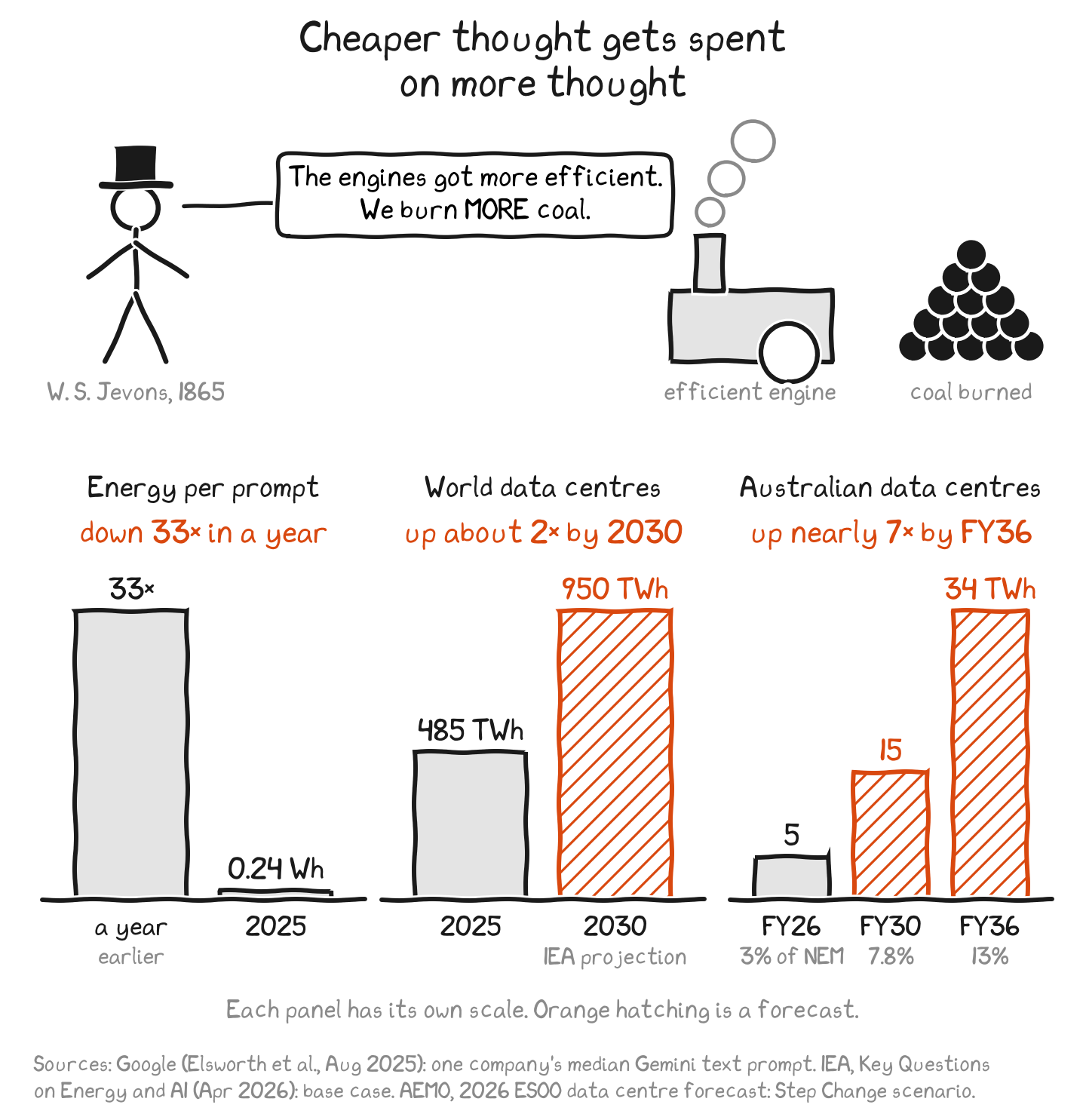
Now the price of intelligence is not the same as the amount of energy consumed, but energy is falling too. Google instrumented its own serving fleet and found that the median Gemini text prompt used 0.24 watt-hours, 33 times less than a year earlier.
The International Energy Agency's April 2026 review says energy use per AI task has been "dropping by at least an order of magnitude annually in recent years". A Stanford group that includes John Hennessy has even proposed the measure I was after: intelligence per watt, task accuracy per unit of power. On local hardware it improved 5.3 times between 2023 and 2025.
Three things are driving these efficiencies: chips get more done per joule. Algorithms improve, so a small model now does what a large one did recently. The Stanford group found small local models could handle 71% of real queries in 2025, up from 23% in 2023.
And competition squeezes margins, which moves the price but not the watts.
Cheaper is not the same as sustainable
In 1865 William Stanley Jevons noticed that more efficient steam engines had not saved Britain any coal. They made coal-powered work cheap enough to do more of it, and the country burned more coal.
AI is following the same path: global data-centre electricity use rose 17% in 2025, to 485 terawatt-hours, and use by AI-focused data centres rose 50%. The IEA expects about 950 TWh by 2030, around 3% of the world's electricity.
The work itself is changing too.
Reasoning, agents and video "can consume hundreds or thousands of times more energy per query than simple text generation". Cheaper thought gets spent on more thought.
Australia's share is bigger than the world's. AEMO's 2026 forecast has about 165 data centres using around 5 TWh in 2025–26, about 3% of the National Electricity Market. In its most likely scenario that demand triples by 2029–30 and reaches about 34 TWh, or 13%, by 2035–36.
What the next generation inherits
Engineers Australia defines sustainability in one sentence, in its sustainability policy: "For our members, sustainability means that future generations will enjoy environmental, social and economic conditions that are equal to or better than those enjoyed by the present generation."
I like that as a test of what we hand to the next generation.
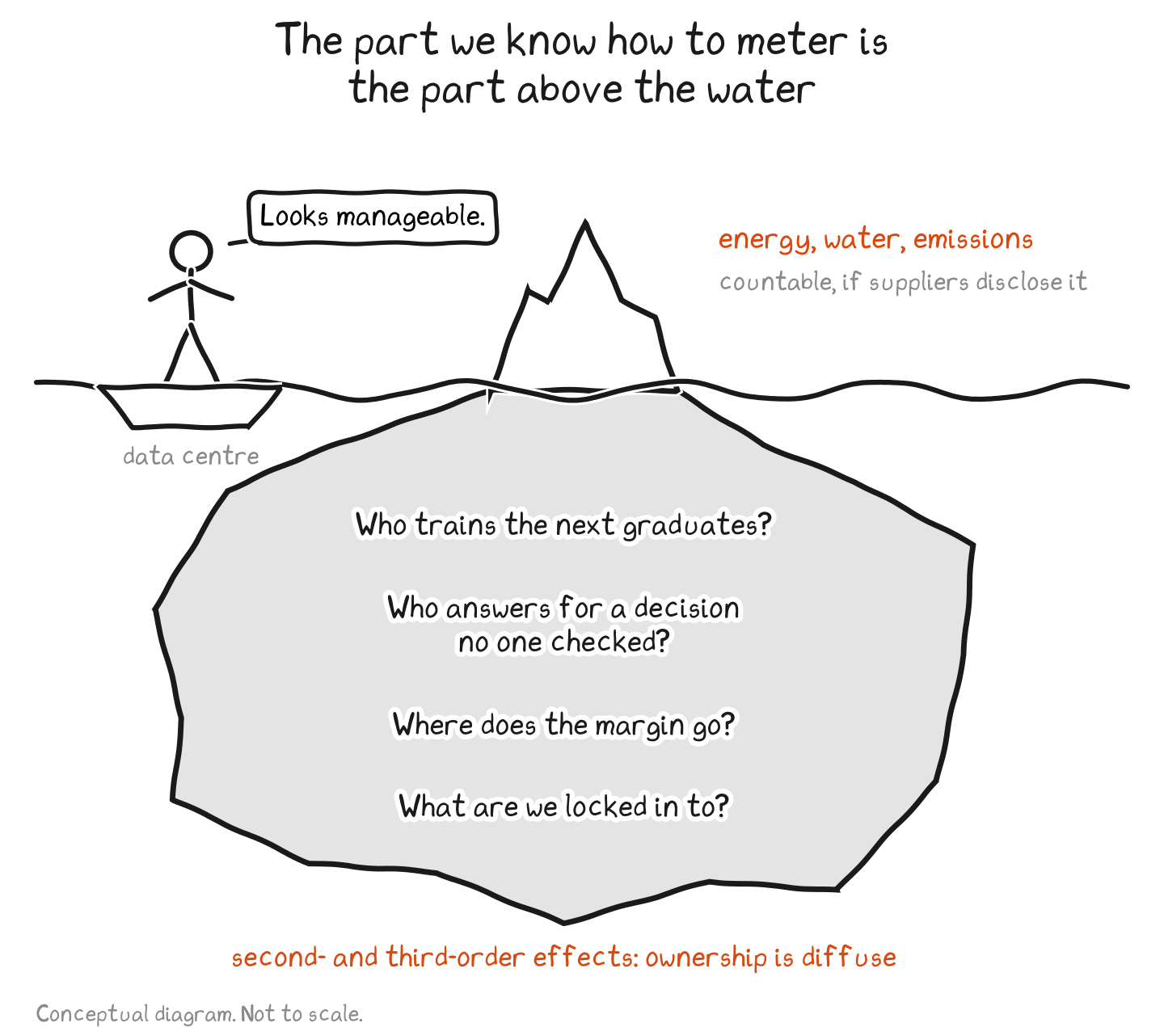
Read that way, AI's energy use is one line in a larger accounting of society's use of technology, and capital allocation. For example, the IEA argues that energy policy and energy technology will move energy demand far more than AI's effect on economic growth will.
The rest of the accounting must be second or third-order effects - the commons - where ownership is diffuse. Who helps the graduates develop their skills when AI can now do most of the things they would have ordinarily been doing? Who answers for a decision no person checked that costs the taxpayer millions of dollars? Where does the value go when the electricity is Australian and the margin is not? There are many more questions than answers at this stage.
Researchers who study AI's footprint make the same point. Luccioni, Strubell and Crawford argue that "a narrow focus on direct emissions misrepresents AI's true climate footprint".
None of these trade-offs should be seen as an invitation to accept a worse environment for a better economy. Economists call that weak sustainability: the capitals substitute, so more of one pays for less of another. Engineers Australia's own guidance rejects it, warning against "trading off environmental negatives for economic positives".
The test is that none of the three gets worse - a stricter test, and one I support.
Five commitments
What follows is what I am committing to for my AI product, Symplast and the company I've founded, Psithur. I'm writing them down so anyone can hold me to them, as well as because I'd like to see more founders building AI products think about sustainability.
1. Count the cost of every unit of work
SENG's first guiding principle is "that a full life cycle analysis and costing should be embedded into all engineering discipline practices". AI products must not treat accounting and audit of their work as an afterthought - you cannot cost a lifecycle you never recorded.
Every model execution in Symplast writes an immutable cost record: the workflow and step it belonged to, the model that ran, the tokens in and out, and what it cost. Executions that fail are recorded the same way. That's how I write about what reading Parliament's mail cost, to the cent (and which stages spent it).
What I can't tell you (yet) is how many watt-hours it took, or where that electricity came from (exactly). Most providers that sell LLM model inference do not report energy or water per request. Google's 0.24 Wh is a median for its consumer chat app, not a figure for a 335-page report. I could multiply our tokens by somebody else's average and print a number to four significant figures - which would look precise but mean very little, so instead we count what we can today, say what we can't count (yet), and make the argument for better data and transparency under commitment five.
2. Use the smallest model that does the job
In June I tested twenty models on Symplast's extraction work. On concrete material (people, places, named events) an open model we can host ourselves matched or beat the frontier model we had been renting, at several times less cost. The ranking that came out was domain, then prompt, then model, and the model mattered least.
Accordingly, Symplast does not send every step to the biggest model - rather each step in a workflow carries its own settings, including which class of model it calls and how much it may spend. When a step's budget runs out, it stops (and says so). Symplast also has first-class tooling for organisations to optimise their LLM usage using a range of benchmarks, in platform. This means organisations can both do their work, and optimise the sustainability of that work, all in the same place (without hiring a team of data scientists!).
This is where sustainability shows up on a balance sheet - by the IEA's numbers, more complex AI tasks can use hundreds of times the energy of a simple query - so assigning the right cost/energy profile across a complex workflow is an engineering decision that should be made on evidence, not guesswork.
3. Draw the boundary around the people
SENG also asks that "all externalities and consequences of engineering decisions be considered and evaluated".
As an economist, I might argue that there's going to be diminishing marginal returns on considering ALL externalities, but I'd be happy to start with most of them. In my opinion, when we talk about AI - the largest consequences actually sit outside the first order data centre impacts - with the people who use the output.
Symplast is not a tool to replace the analyst: it does the reading and cross-referencing no team has the time for and leaves the judgement with the expert. My version of AI is expert-empowering - giving knowledge workers the ability to do work they just otherwise wouldn't have been able to contemplate.
And, because Symplast is explicitly designed for high-stakes work, accountability matters and its analysis must stand up to scrutiny.
Engineers Australia told Parliament in September that AI "cannot carry legal or professional responsibility". I can see why EA would take that position, but for me the question should not be about whether AI carries legal or professional responsibility. No one suggests CAD software has legal or professional responsibility, but certainly engineers use those sorts of tools all the time in the execution of their duty.
For me, the question is about how do we safely use AI to solve challenges that are currently unsolved. When nobody has time to make a decision, or to complete the required analysis, who is then held accountable for a subsequent failure?
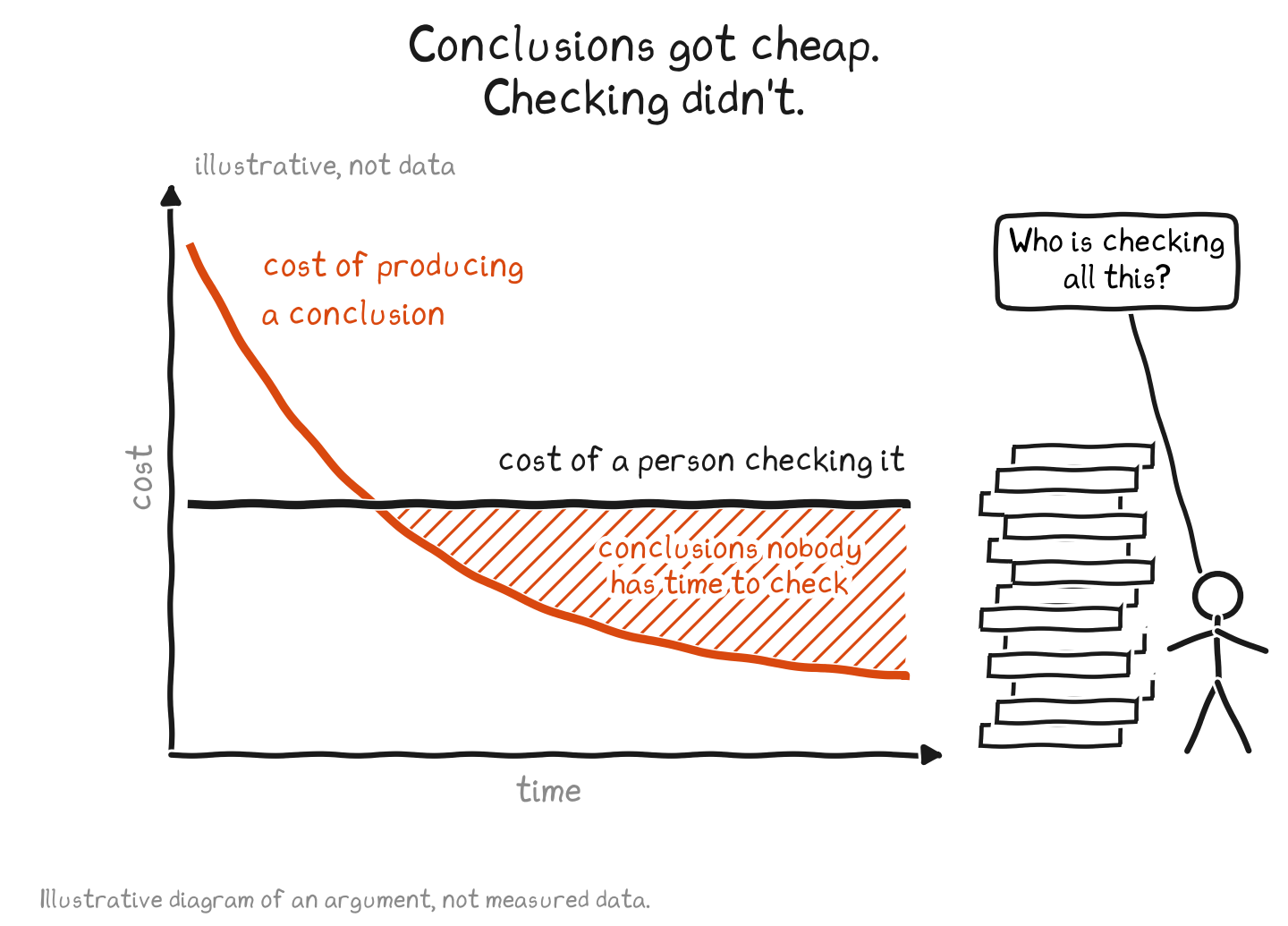
Conversely, when a system produces more conclusions than anyone can check, the shortfall does not disappear - it piles up as decisions nobody will account for, and the next generation inherits them.
So the boundary I draw - when thinking about the impacts of AI - includes both the opportunity cost of not using AI (in a safe manner) and the opportunity cost of not keeping up with what the rest of the world is doing.
Rather than saying what AI cannot do, I'd pose the question as "can a person check this work, and how long will it take?" A system that makes analysis cheap and checking impossible has moved the cost, not removed it. AI can do both - make analysis cheap and make checking impossible - yet the focus seems to be the former.
4. Keep Australia's options open
Engineers Australia's policy applies the precautionary principle where the evidence is incomplete. The aim is "to ensure irreversible negative consequences are avoided and not passed as a liability to future generations".
Lock-in is that kind of consequence. So is a lost skill base. And I would argue, so is a lost strategic opportunity.
Australia has form here. According to Engineers Australia's submission to the AI inquiry, in-house engineering expertise in government has fallen 40% since the 1980s. Seventy thousand engineers are due to retire in the next decade. And the workforce is "deeply reliant on skilled migrants". AI is now taking on some of the junior work people used to learn on. EA's national president, Tom Goerke, put it well: "we should preserve the learning pathway that creates experienced engineers."
I can't set national skills policy (fortunately?) - but I can make sure the AI that does high-stakes Australian work does not have to live somewhere else. Symplast is designed to run in any cloud, or offline in a customer's own data centre. Every workload that can move home is an option kept open, an option kept sovereign.
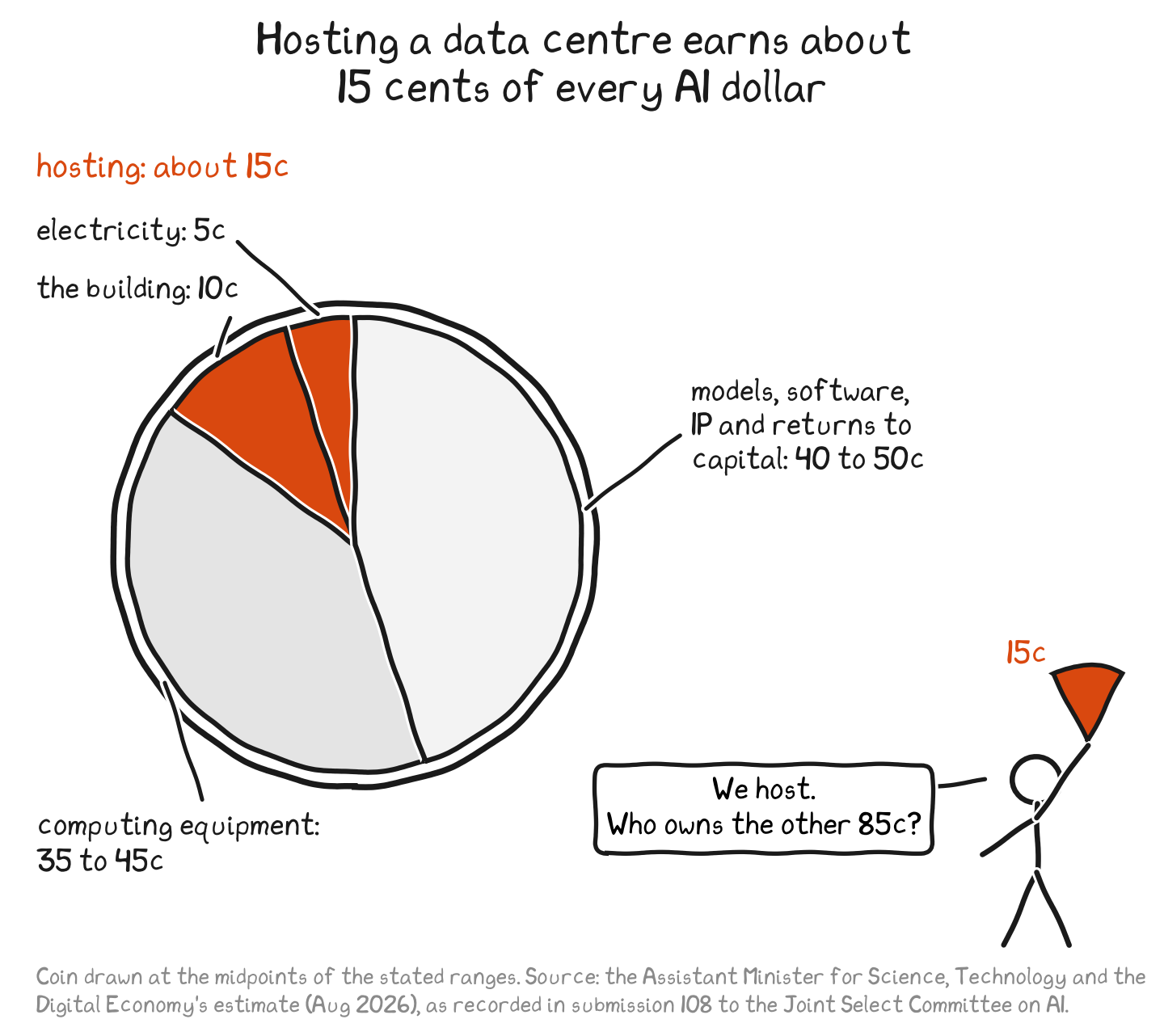
The arithmetic explains why it matters. A submission to the same inquiry records the Assistant Minister tracing the AI dollar. About five cents goes to electricity and ten to the building. Another 35 to 45 goes to the computing equipment. The remaining 40 to 50 goes to "the models, software, intellectual property and returns to capital further up the stack".
Host the data centres and import everything above them, and the grid load stays here while most of the rest of that dollar leaves.
5. Publish the meter, failures included
The Commonwealth already asks part of the right question. The DTA's AI technical standard says agencies must "assess environmental impact and sustainability", because AI systems "may have corresponding trade-offs with electricity usage, water consumption, and carbon emissions".
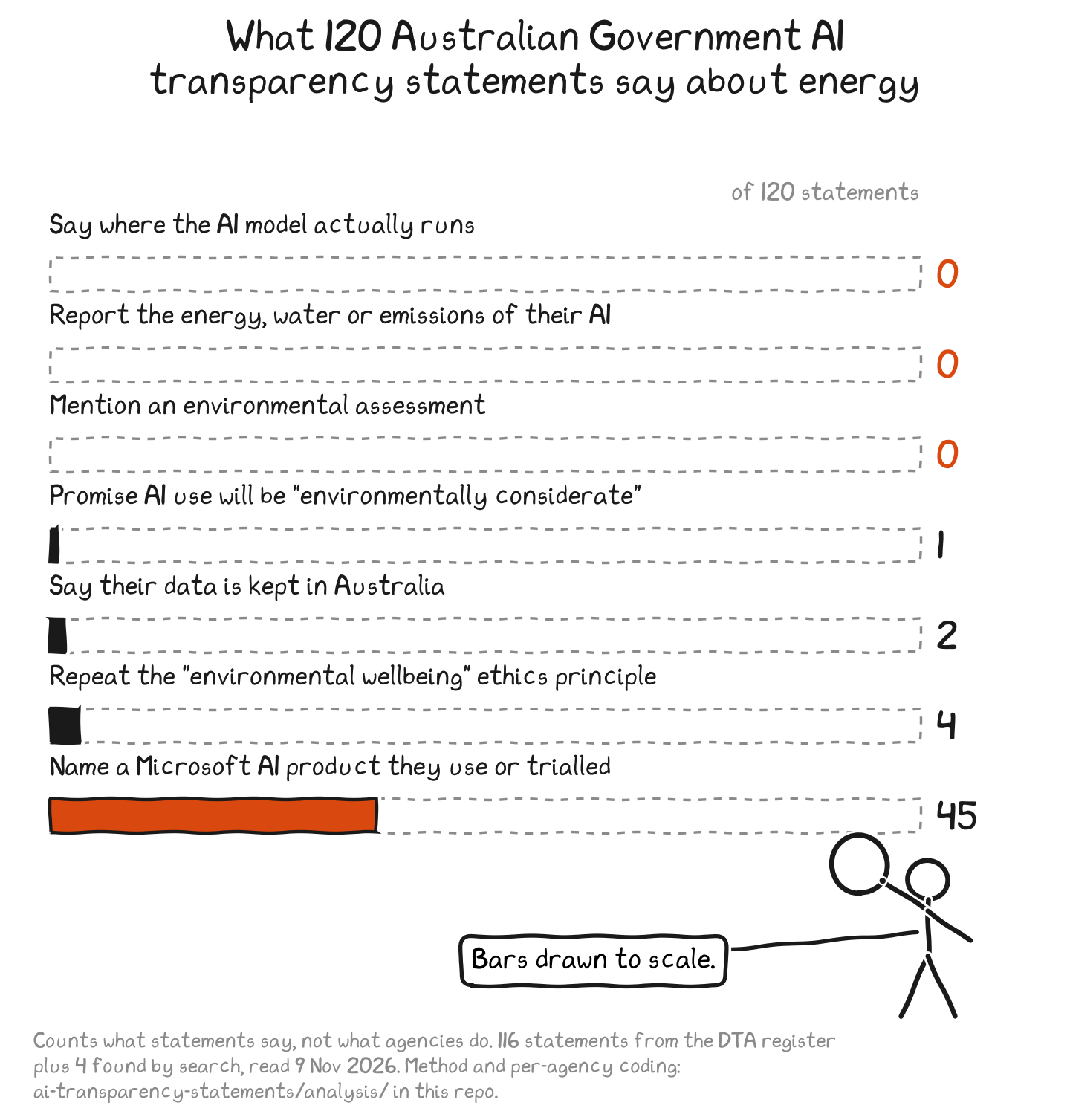
At the moment, those answers are not publicly published. The standard for AI transparency statements, the public statement agencies must publish, sets seven minimum requirements and none of them is environmental. Agencies "are not required to list individual use cases".
On 9 November I downloaded every transparency statement I could find: the 116 on the DTA's register, and four more by search. None mentions an environmental assessment. None reports the energy, water or emissions of the agency's AI use. The Climate Change Authority comes closest: it promises AI use that is "environmentally considerate", and stops there. None says where inference runs.
Emissions reporting does not catch it either. Finance's Emissions Reporting Framework counts electricity in an agency's own buildings and a short list of other sources, such as flights and waste. Purchased services are not on the list, and AI bought from a cloud provider falls outside it. An agency could move its AI work into someone else's data centre and see its reported emissions go down.
So this is my ask, of the Commonwealth and of the States:
- Put energy, water and emissions in AI transparency statements, for each use case.
- Report them per outcome achieved: per application assessed, per report delivered, per decision supported.
- Report the work that achieved nothing too: the abandoned pilot, the system switched off, the run that failed. Those watt-hours and litres were spent as well. An account that lists only the successes is surely incomplete.
- Make suppliers hand over the numbers as a condition of the contract. Government cannot publish what its vendors aren't asked to disclose, and government is a large enough buyer to move expectations here.
The IEA is asking for "more systematic energy consumption disclosures". Google has shown that per-prompt energy can be measured at fleet scale. The Commonwealth is developing AI legislation for early 2027 and a set of Australian Standards for AI. That makes now the time to fit the meter.
To be clear, I'm not suggesting these are the only things we need to measure: to understand the opportunity cost of using AI against other options (to achieving a specific outcome) still requires the ability to do the accounting of those other options, as well.
Intelligence is no longer a scarce input
Intelligence is now the cheapest input in the system, and it gets cheaper every quarter.
The person who checks the work does not get cheaper though; in fact (and I'm not the first to point this out) as intelligence gets cheaper, the demand for experts who can assess it can only increase.
Sustainability - in Engineers Australia's terms - is a promise about what the next generation inherits - the five commitments above are how I mean to keep them, at least in my corner of the world.
If you or someone you know is building AI products, ask what sustainability means to them, or, if you're buying AI on behalf of the public, be bold, and ask for number five.