Who is the customer now?


AI, public service product development, and the economics of building Australian capability
Near the end of the AI Government Showcase in Canberra on 11 November, I asked a panel a question I had been asking people throughout the day:
Government is building a lot of AI capabilities in-house. How do you feel about that?
David Turner, Principal at Empirical Legal, had presented Lext Australia, a Sydney company that builds legal software and tailored tools. He gave a more interesting answer than a supplier's pitch for government to buy more software.
Large agencies with expertise in their own field, he said, could be well placed to build internally. Smaller agencies and independent commissions also had specialised problems, including legal problems, without the engineering and legal expertise to build the tools themselves. He floated an engineering equivalent of the Australian Government Solicitor. There was also a place for a company like his.[1]
That answer makes room for three sensible arrangements: an agency builds, a common provider supplies a capability, or a company develops a product. It leaves the difficult question open. How should government choose?
There is a strong case for greater technical capability inside the Australian Public Service. Public servants know things about policy, legislation and operations that are expensive to transfer to anyone else. I used to work in the Australian Taxation Office's central data mining centre of excellence. I have seen both the value of that knowledge and the institutional difficulty of using a tool the organisation did not already know how to accommodate.
AI-assisted development may let those people work much more directly on the tools they need. But making software easier to produce changes the cost of beginning. It does not, by itself, establish the cost of owning the result: keeping it reliable, knowing whether it works and changing it when the service changes.
Three customer relationships run through that choice. The public needs a service that works. An agency using a shared platform needs a provider that responds to its requirements. An Australian technology company needs a government customer willing to commit to using and paying for a useful product. The same institution can be serving the first, supplying the second, and competing with the third.
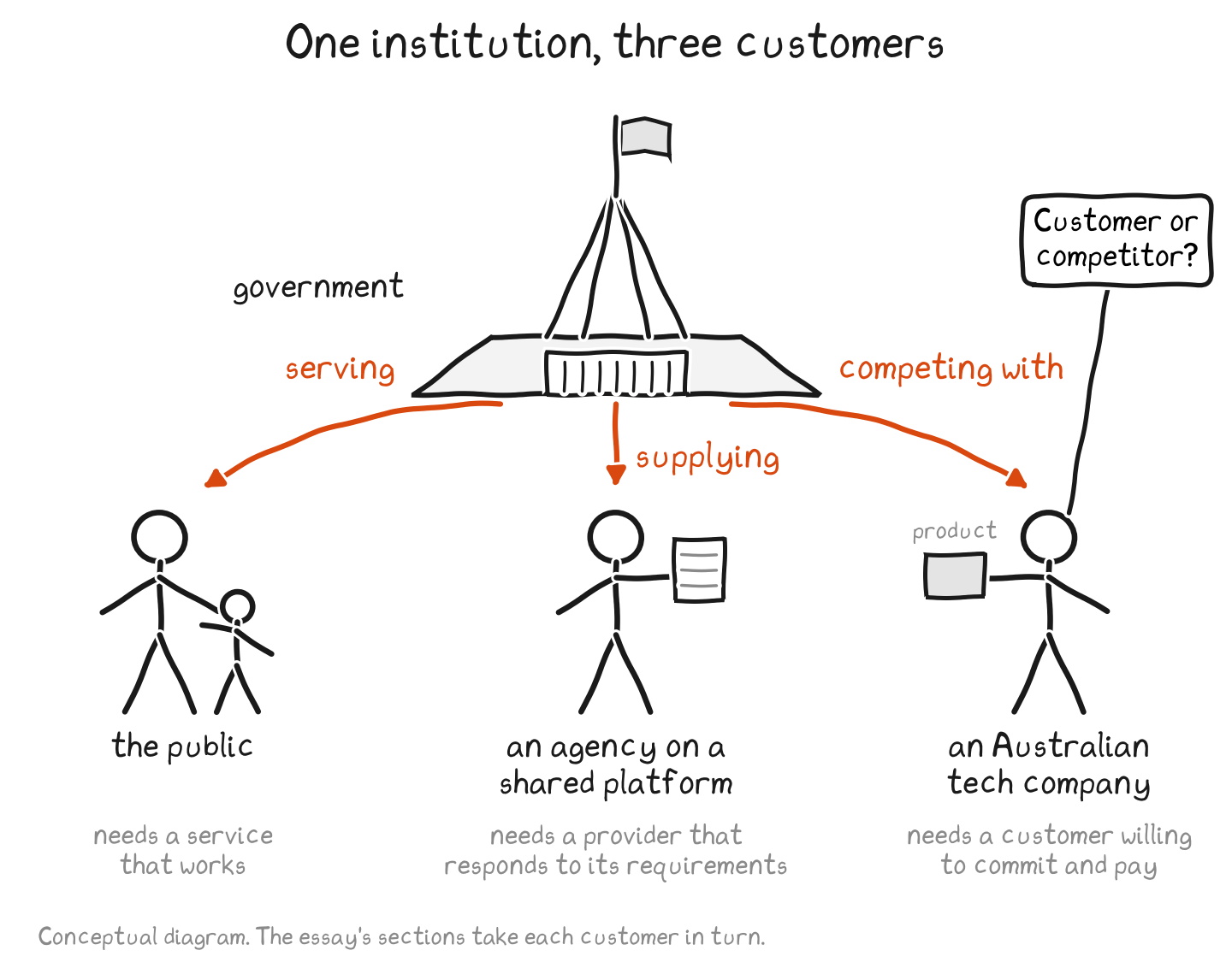
One institution can serve the public, supply agencies and compete with Australian companies at the same time.
My working rule is to build where the work is specific to government, central to the mission and frequent enough to sustain a capable team. Share common infrastructure while preserving the agency's ability to adapt its application and leave. Where the need is generic and a workable market exists, prefer to be a demanding customer. Keep enough technical skill to judge, evaluate and change the arrangement in every case.
That rule requires someone who can say a product is not working and has the authority and money to fix it. The evidence below is why I think that condition deserves as much attention as the ability to write software. The indicators at the end are how I would test the rule.
The cost of beginning
The strongest version of the internal-development argument starts with the cost of coordination.
A public servant knows why a particular exception exists, which apparent duplication is required by legislation, and which procedure survives because nobody can remember who authorised it. Explaining that to a supplier takes time. Writing it into a contract takes longer. Discovering that the explanation was incomplete after the contract has been signed can be expensive.
Put a capable engineer next to that public servant and some of the explanation becomes a conversation. Give both of them better development tools and they may be able to test an idea before preparing a large business case. The advantage is particularly plausible for a narrow application around a specialised government workflow.
Government can also share what it develops. At the showcase, Katy Gallagher, Minister for Finance and the Public Service, described Finance's common AI offering, GovAI. It includes GovAI Chat, shared hosting and an Exchange for agency applications. Her ambition was that “what one agency builds, every agency can use.” A small agency gaining access to secure infrastructure and an existing tool may avoid substantial purchasing and operating costs.[2]
However, AI-assisted development is available to the supplier as well. If it reduces the cost of building a product for a public team, it may reduce the cost for a company that can sell the result to twenty customers. Lower development costs can make internal production more attractive. They can also make a specialist supplier cheaper, allow a smaller Australian company to compete, or make an existing product easier to adapt.
Lext supplies an example of that second possibility. It built a tool for LawAccess NSW, the legal information and referral service of Legal Aid NSW. The tool draws on the service's own resources to draft cited responses for the staff who answer the public's questions. This is a state service, but the arrangement is relevant: a specialised workflow, knowledge held by the service, and a small Australian supplier building the tool. Policy knowledge and external engineering can work together.[3]
There is evidence that coding assistants can increase output. A June 2025 study combined randomised field experiments involving developers at Microsoft, Accenture and another large company. Its pooled estimate was about 26 per cent more completed tasks with access to an assistant. Completed tasks are a different measure from the cost of delivering and operating a service.[4]
Measuring the effect is getting harder as tools and working practices change; METR's February 2026 account of problems with its follow-up experiment is a useful warning.[5]
It helps to make the arithmetic explicit. Suppose, purely as an illustration, that initial coding accounts for 20 per cent of a product's whole-of-life cost. Halving that coding cost would reduce the total by 10 per cent, before any other effects. If faster development also reduces integration and testing effort, the benefit could be larger. If it produces more software to secure and maintain, it could be smaller. Neither percentage is an estimate of APS costs.
An honest comparison needs to include understanding the service and getting the product into operation, then securing, evaluating and supporting it. It must include ongoing changes and eventual replacement. Public servants' time counts even when their salaries already appear in somebody else's budget. Procurement and contract management count on the buying side too.
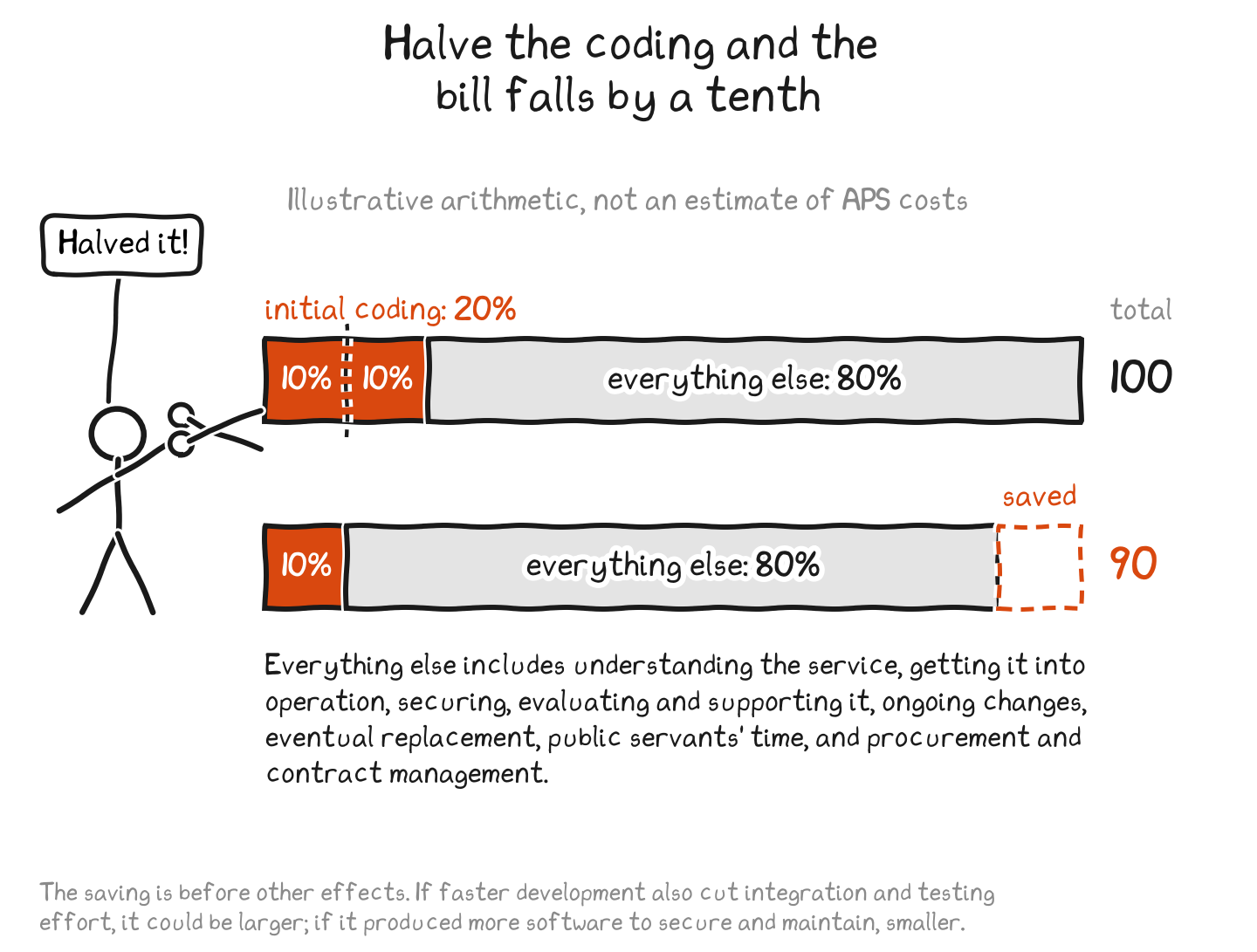
If initial coding is a fifth of the whole-of-life cost, halving it saves a tenth.
There may be good reasons to spend more initially to retain control or develop a capability that government needs. Those reasons should appear in the decision, with evidence about what capability will actually remain. A unique statutory calculation and a general document-management interface have different economics. So do a prototype used by three analysts and a service that thousands of people depend on every morning.
The benefit also has to be measured on the service. The Productivity Commission's Report on Government Services, or RoGS, already reports measures of quality, access, equity, efficiency and outcomes. A technology business case should connect to relevant existing measures and identify what it expects to change. Lower average unit costs alone may conceal poorer quality or reduced access for people with complex needs.[6]
RoGS covers services across jurisdictions, often delivered by non-government providers. It does not cover every Commonwealth function or evaluate individual software products. Its measures can inform a product evaluation where the service, population and period align; they cannot substitute for identifying what the product actually changed.
Steve Blank, reflecting on teaching entrepreneurship in the AI era, put the distinction well:
While AI accelerates product development and customer discovery, it doesn’t accelerate understanding, evidence or insight.[7]
The next section examines that constraint. A cheaper beginning is valuable when the institution can turn it into a service it understands and can improve.
The cost of owning
In 2012 or 2013, as I remember it, my team in the ATO's data-mining centre wanted to put a model into production. We had built it in R, the open-source statistical language. We wanted to use it because that was where the frontier of our work was.
The process for putting software into production asked what the software was and which vendor supported it. R did not have a vendor in the usual sense. The capability we wanted came from an open-source project and the people who knew how to use it.
We had to fight hard to get it accepted. In the end, we found an overseas company that sold commercial support for R. I no longer remember the company. The support contract was enough to satisfy the process. As far as I recall, nobody used that support while I was there.
Corporate IT was asking a fair question. Software in production needs someone responsible for it. What got us through the process, though, was an overseas vendor contract. The people who understood the model and wanted to operate it were already inside the ATO.
By 2016, an ATO data-scientist advertisement referred to “corporate analytical toolsets including tools such as JMP, R and SAS”. More recent procurement records show SAS licensing commitments through June 2027.[8]
The records show coexistence in recruitment and purchasing. An agency can build models with open-source libraries, run them on commercial infrastructure, retain a proprietary analytics platform and buy specialist support. “In-house” describes only part of that arrangement. The more useful question is which knowledge and decisions the agency retains.
The ATO's October 2024 submission to a parliamentary AI inquiry described an established specialist data-science hub and internal development using pretrained models and open-source software.[9]
The Australian National Audit Office's February 2025 audit recorded 43 internally developed AI models in production as at May 2024. Its overall assessment was partly effective. For the 14 sampled models built and deployed between July 2023 and May 2024, it found no evidence of ongoing performance monitoring and reporting.[10]
The organisation could produce and deploy models. The audit questioned whether the arrangements around those models adequately established how they were performing. A headcount of data scientists cannot answer that finding.
My support-contract story and the audit concern different work, separated by more than a decade. They ask different questions too. Who supports the software? Is the model still working? An answer to the first does not supply an answer to the second.
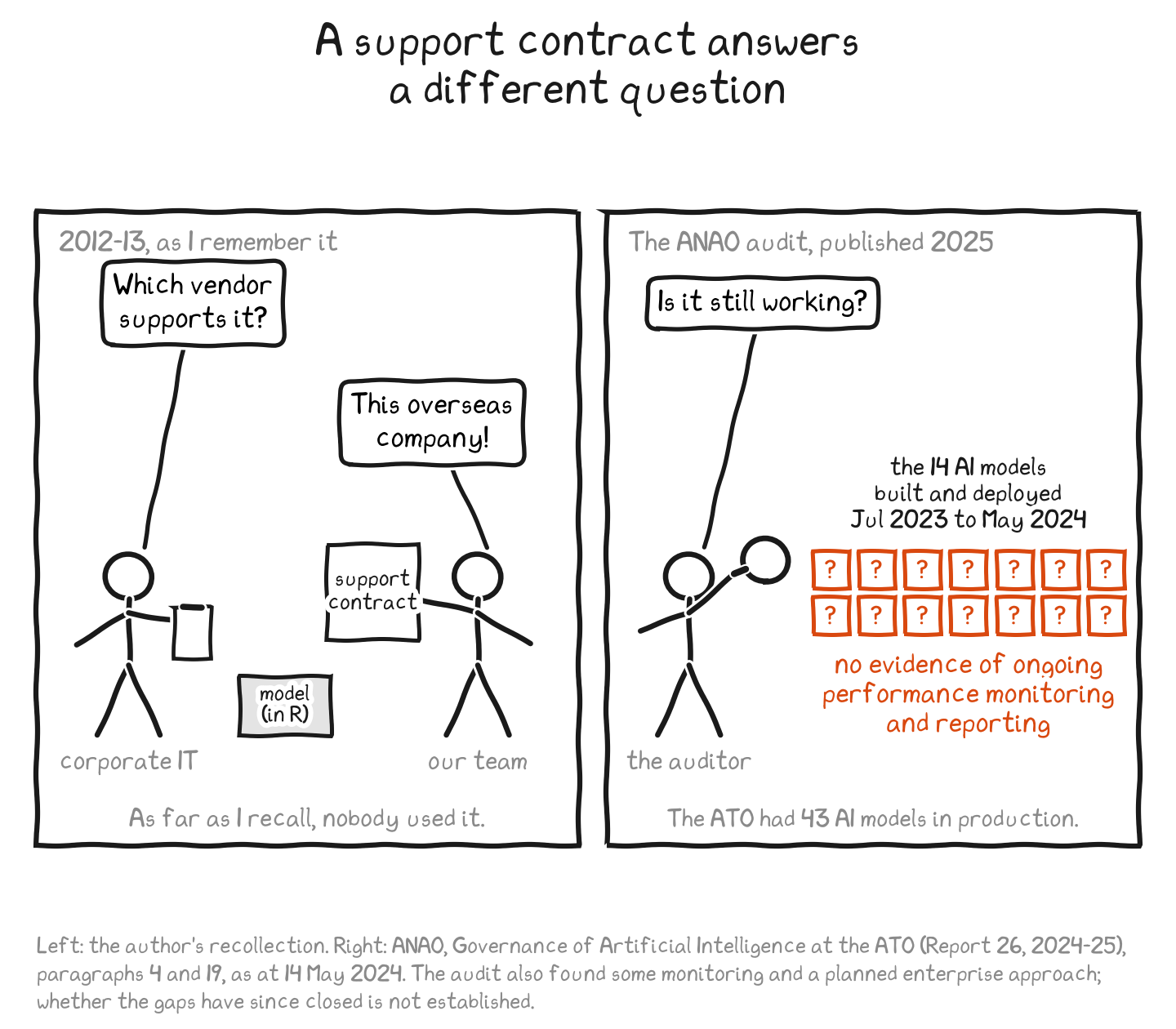
"Who supports the software?" and "Is the model still working?" are different questions.
There was contrary evidence in the audit: some model monitoring, changes in reporting and planned enterprise monitoring work. A project was planned for December 2026, next month as I write. Whether the gaps have now been corrected needs a current answer from the ATO.[10:1]
Is the ATO unusual? I began this research with a suspicion that government was embracing product development without taking its obligations seriously enough. Reading APS job advertisements, procurement notices and government-directory histories required a more careful claim. These records describe intended responsibilities, purchasing commitments and continuity. They offer evidence about how government organises the work, rather than a verdict on which delivery model works best.[11]
Several advertisements explicitly describe the less glamorous parts of product ownership. An ATO DevOps role covers maintenance, modernisation, decommissioning and operational support. Services Australia combines AI development and deployment with reliability, privacy and security. The Department of Veterans' Affairs recruits for reusable code, metadata, testing and priority-setting.[12]
The Apprenticeships Data Management System, which supports apprenticeship administration, shows the same mix. The Department of Employment and Workplace Relations advertises internal development, release and product responsibilities, while procurement records show external project-management and delivery services. Government leadership and external participation coexist.[13]
I also expected technical functions to be vulnerable to constant leadership churn. Some directory histories instead showed continuity through restructures and changes in senior leadership. A changed role identifier can record the same person doing the same work. Multiple rows can represent acting arrangements. Counting those rows as departures would produce an impressive chart of something other than turnover.[14]
Those are substantive findings against a blanket claim that the APS launches technology and forgets it has to run it. The distinction I would now make is between responsibilities in a position description and responsibilities that survive a budget decision. Is the team filled? Can it change the workflow? Does it have funding for improvement? Does evidence from users and production change its priorities?
The foundations across government also remain uneven. The 2024 APS Data Maturity Report, published in March 2025, reported an average self-assessed score of 2.02 out of five, classified as Developing. Data architecture, data quality/reference/metadata, and data analytics were at the initial or ad hoc level. About a fifth of agencies had not appointed the appropriate senior leader responsible for data.[15]
In Deja Vu, I called that a “woeful state”. I still think the weaknesses matter. Reading the report again alongside evidence of functioning technical teams makes me more cautious about turning the average into a judgement about every agency. Developing maturity may suit some agencies; organisation-wide scores can also conceal stronger teams. My concern is more precise now: a capable team still needs reliable information and authority over its sources.[16]
An assistant working over inconsistent records gives the inconsistency another interface. If nobody owns the task of updating a source, identifying the authoritative version or correcting an error, the model cannot supply that responsibility.
At a May 2026 Senate Estimates hearing, where senators question ministers and officials about public administration and spending, Digital Transformation Agency chief executive Chris Fechner drew a useful distinction. He said all entities in scope complied with the responsible-AI policy. Pressed about readiness, he explained:
Whether an agency is using AI because they're ready for it or not is actually not what the policy requires[17]
A compliance count answers a question about the policy. It leaves operating capability to be established through evidence of reliable sources, tested outputs and incidents detected and corrected.
At an April 2024 Joint Committee of Public Accounts and Audit hearing, the employment department's Adam Shain described the remaining difficulty with the Workforce Australia digital platform:
Generally we've done pretty well at getting the sustainment to keep the systems running. But how we make it perform and meet the needs of users is the trick that we are grappling with.[18]
That is the cost of owning. Keeping a system available and improving the service are separate achievements.
The public as customer
Knowing the policy is part of knowing the product. The public servant closest to the policy may be the best person to explain a requirement. The current requirement may still be the wrong starting point for the service.
A policy owner, a call-centre operator and a person applying for support can all describe the same transaction differently. The policy owner needs the decision to be lawful. The operator needs to resolve the case. The applicant needs to understand what is being asked, provide it once and get a reliable answer. A finance team may mainly see the cost of processing the transaction.
A product team has to work through those differences. It needs to find out what people actually do, decide which problems matter, test an alternative, operate it and change it as circumstances change. Much of that work requires authority over the process the software represents.
Imagine a team builds an excellent assistant that explains a confusing form. That may help. But if the confusion comes from asking people for information the agency already holds, someone needs to authorise a different process. A faster explanation preserves the cost of the original decision.
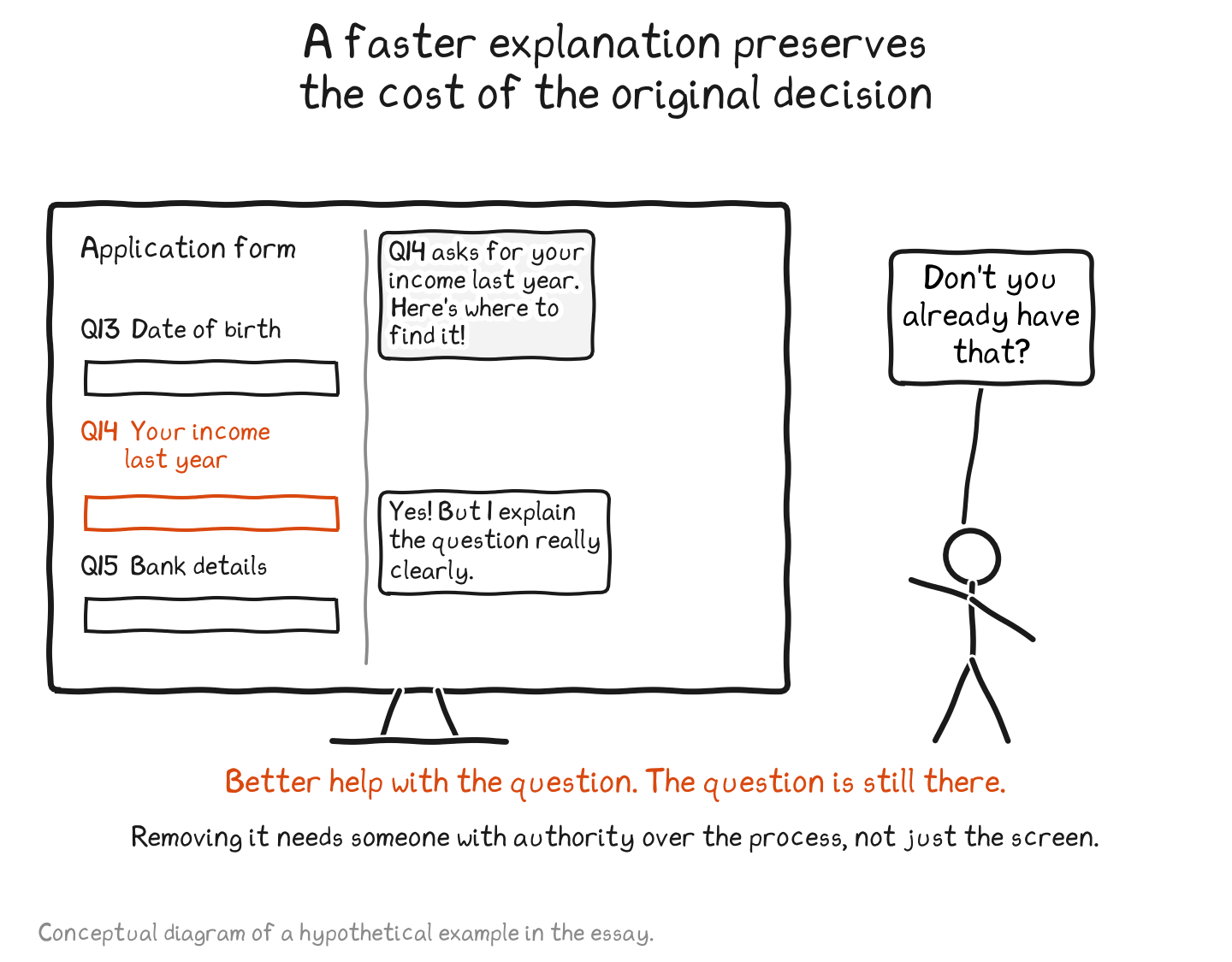
A better explanation leaves an unnecessary question in place.
The same problem appears when an assistant helps staff navigate a backlog. A shorter handling time is useful. If the team can also remove an unnecessary referral, correct a recurring data problem or change a delegation, the gain may be larger. The software team needs access to someone who can make those decisions. Otherwise its product can become very good at helping people work around a rule nobody has reconsidered.
This is where being an informed buyer and being a product developer diverge. An informed buyer needs enough technical understanding to judge an offer, challenge a claim, evaluate the result and retain meaningful choices. A product developer also takes on a continuing production obligation. It decides what to build next, which defect displaces planned work and how the service keeps running after the original team leaves.
An agency needs to define a lawful outcome, test whether its service delivers it and decide what must change. Where that work is central to its mission and repeated at scale, operating and modifying the product may be a core capability. A small agency may be better served by shared or commercial provision. It still needs the expertise, evidence and rights to challenge its provider.
Gallagher's speech recognised skills, fiscal limits, data quality, legislation and legacy systems as barriers. The question is whether the institution can act on the limits its leaders already describe.[2:1]
For the person applying for support, the meaningful change is a service that becomes easier to use and more reliable. Whether the improvement came from an APS engineer, a common component or a supplier matters mainly through its consequences for that service and the ability to keep improving it.
The agency as customer
There is a useful symmetry in the case for GovAI. At its showcase presentation, the team explained why a separate government chat tool could make sense alongside Microsoft Copilot. Some work sits outside Microsoft's environment. Different models have different strengths. Government also wants control over which features it prioritises, rather than relying on Microsoft's roadmap.[19]
That is a reasonable argument for retaining choices. An agency may have the same reason to want choices within GovAI. Its priorities will not always match the common platform's priorities.
Turner's proposed engineering equivalent of the Australian Government Solicitor would also have agency customers. It would need to explain how they could influence priorities, obtain changes and leave for another provider.
Central development has an obvious economic attraction. The APS should not need a separate version of every undifferentiated tool in every agency. Common hosting, identity and evaluation infrastructure could remove costs that small agencies cannot sensibly carry alone.
Agency autonomy has costs too. A team building around its existing vendor's tools may avoid an unfamiliar integration while deepening an expensive dependency. The local decision can be reasonable even as the Commonwealth loses future choices. Gallagher explicitly identified vendor lock-in as a legacy-system problem.[2:2]
A common platform could pool expertise and make alternatives easier to test. It could also concentrate dependence on one architecture or approval process. The same questions about changes, priorities and exit apply to a public provider as to a commercial one.
PEMS, the Parliamentary Expenses Management System, records the customer's position unusually clearly. At Estimates in May 2026, Christina Grant, chief executive of the Independent Parliamentary Expenses Authority, described sitting on the project board. Her team developed requirements and collected feedback from parliamentarians and staff. She then explained the limit:
But, obviously, we are limited by the scope and budget of the system and the fact that it's a Department of Finance system.
On improvements, she said:
There's quite a long lead-in to PEMS improvements. You're looking at 12 to 18 months.[20]
IPEA had a voice, a board seat and a requirements process. Customer influence and delivery authority were still different things.
Grant also said some staff and parliamentarians liked PEMS. She described continuing improvements and competing work, including regulatory changes. A commercial supplier could face the same constraints or perform worse. What matters is how competing demands are resolved, and who bears the consequences of delay.
One correction shows how obligations persist after a product exists. Finance was accommodating staff ceasing and recommencing employment after a day's break, including termination payments and immediate system access. By October 2026, officials described a technically complex correction extending into 2027, with work inside Finance and with SAP Australia and SAP India.[21]
The issue was a particular entitlement and correction. It illustrates the continuing work of integration, data integrity and upgrades that easier code production does not remove.
GovAI's wish for control over Microsoft's roadmap and IPEA's dependence on Finance's scope and budget belong in the same argument. Moving a provider inside government can change the relationship. It does not remove the need for a customer to obtain a change.
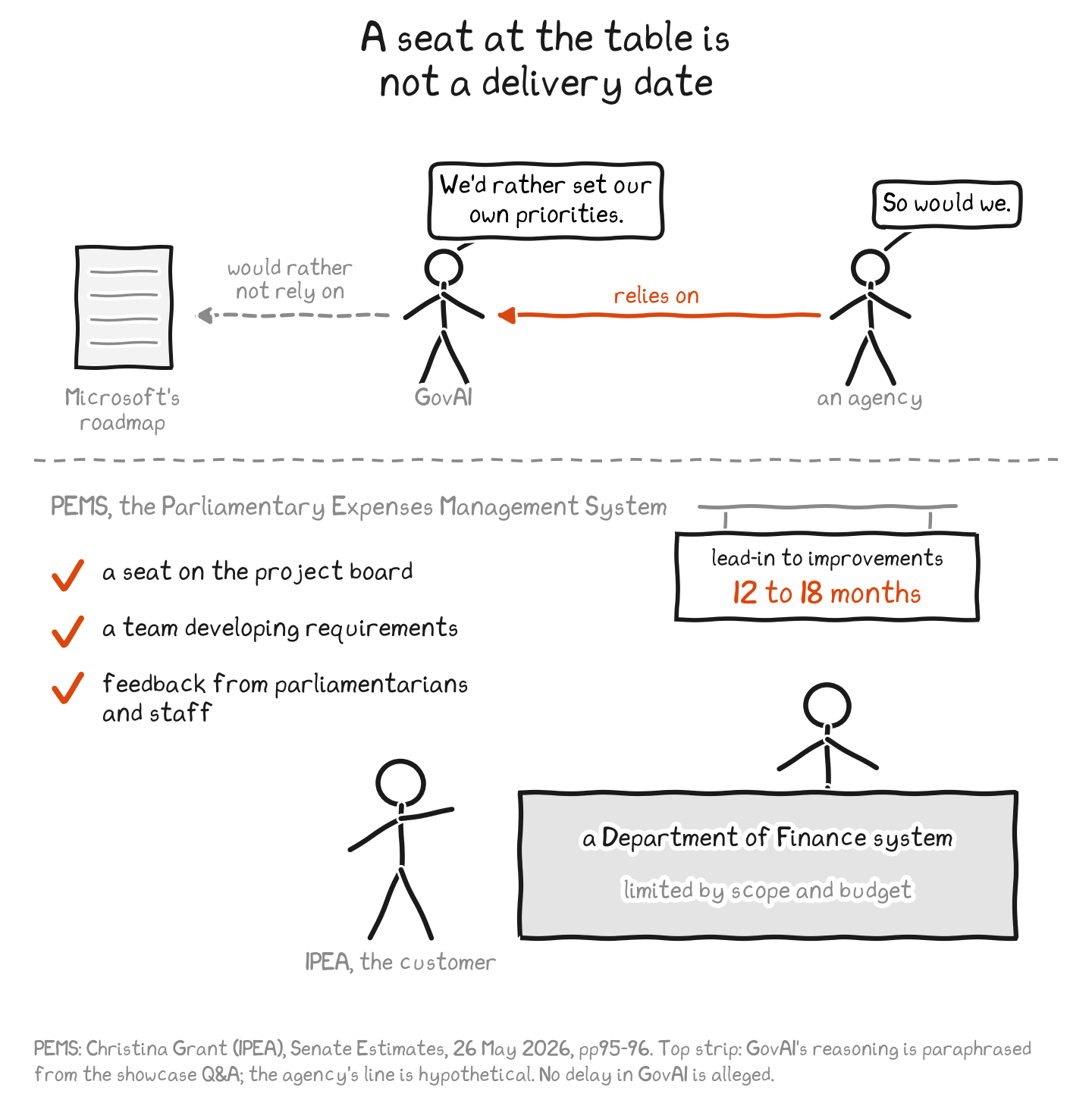
Customer influence and delivery authority are different things.
I raised a related concern last year in The All-Singing, All-Dancing Central Team: a central unit can become adept at navigating agency processes while lacking the authority to change them. The current evidence gives me a more concrete test. Can the team with the service problem get a reasoned decision and a funded correction?[16:1]
GovERP offers a warning about where to draw the common boundary. It was an attempt to provide common enterprise resource planning for government: the systems behind functions such as finance and human resources. At Estimates in May 2024, Finance Secretary Jenny Wilkinson described the late-2023 decision:
… to move away from the idea that there would be one GovERP program and to recognise that different agencies have different needs.
She also recognised switching costs and the value of competition among providers.[22]
A shared catalogue or hosting environment differs from putting agencies onto one enterprise system. Shared infrastructure can support different applications. The decision is about what is genuinely common and what needs to remain adaptable. Procurement categories can make different workflows look alike; agency boundaries can make identical infrastructure look different.
The cost of an unmet specialised need belongs in that decision too. A common backlog may favour requirements shared by many agencies. A requirement affecting a small agency or a few users may still be important. Reuse savings need to be considered alongside integration effort and delayed improvements.
Funding can obscure the comparison. If the common tool carries no charge to the agency, a commercial alternative appears as a new expense against something that looks free. The shared tool still consumes public resources. Central funding may sensibly encourage adoption and avoid duplication, but the agency's budget comparison then differs from the Commonwealth's whole-of-life comparison.
For GovAI, I would like the customer relationship made explicit early. Who decides the common backlog? What can an agency change itself? What happens when its urgent need is not a central priority? Can it use another supplier or model without rebuilding everything? Those are practical tests of the control that building a public platform is meant to retain.
Government as the industry's customer
At the showcase, Gallagher made the industrial ambition explicit:
As a big purchaser of technology, it is in government's interest to build that capability here.
She said government wanted more companies developing AI tools in Australia, alongside common tools and agency applications.[2:3]
There is a history behind that proposition. Steve Blank's Secret History of Silicon Valley describes the US military and intelligence community as early customers for the Valley's electronics companies. Daniel Gross and Bhaven Sampat found that wartime research contracts catalysed technology clusters, with effects persisting into the 1970s. Government demand and research funding helped create capabilities that later found other customers.[23]
The integrated circuit supplies a particularly concrete example. Early chips were expensive and had few customers willing to pay for their advantages. Aerospace and defence provided demanding applications and volume. The Engineering and Technology History Wiki records prices falling from about US$1,000 in 1960 to about US$25 by 1963 as Apollo demand grew.[24]
Australia is not the Pentagon, and an APS application is not the Apollo programme. The mechanism still matters at a smaller scale. Someone pays for early learning. The product improves, the supplier learns to deliver it, and a reference customer helps make the next sale possible. A government that always builds the first version itself may give up that role. It may retain valuable public capability instead, but the industrial consequence should appear in the comparison.
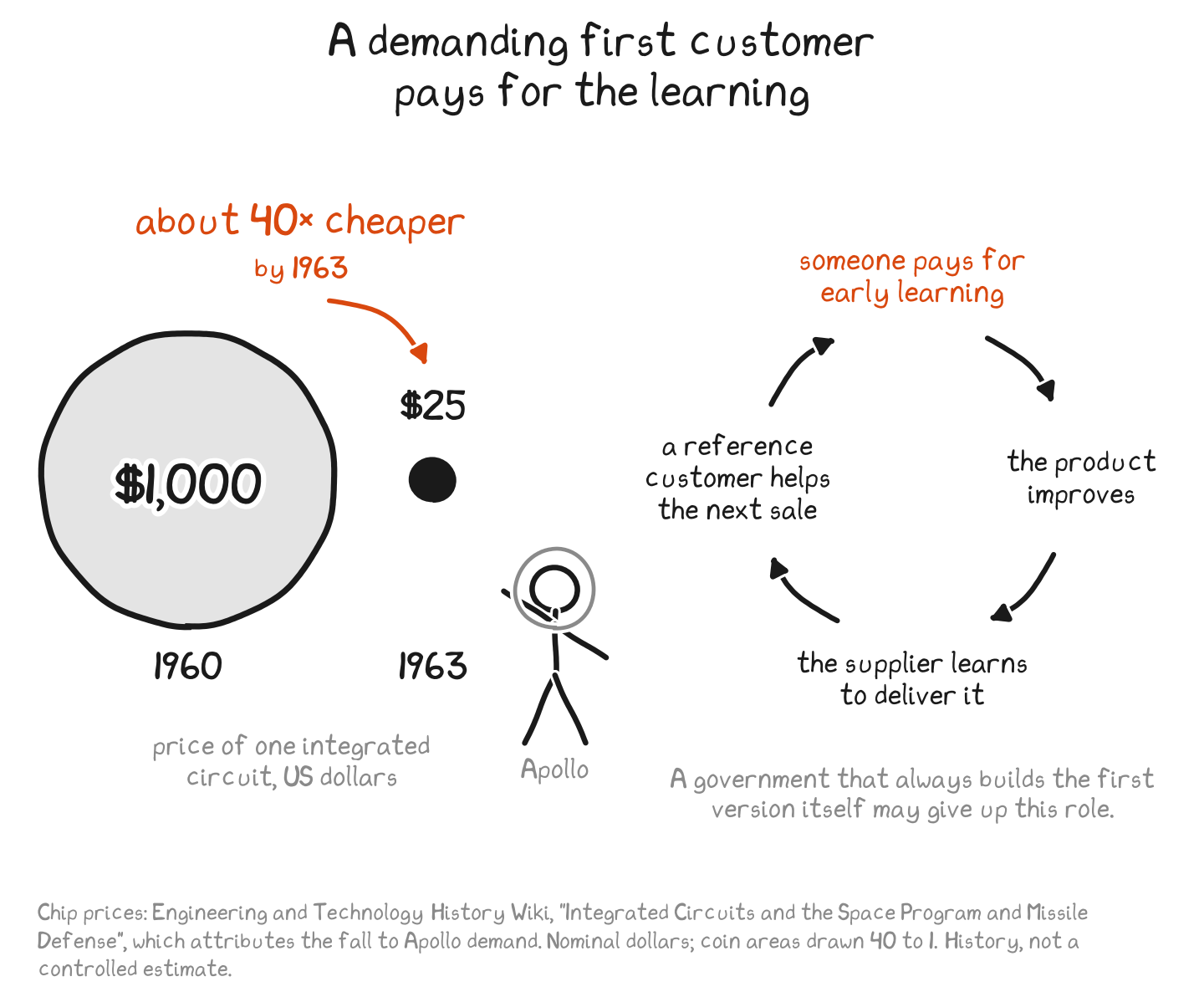
Someone has to pay for early learning. A government that always builds the first version itself may give up that role.
This is not a reason to buy something simply because its maker is young or Australian. It is a reason to consider a paid development partnership where an agency has a real need, a supplier has a credible approach and the resulting capability could serve other customers. The government remains responsible for testing the product and protecting the service.
There is evidence that early funding can change a firm's prospects. Sabrina Howell's study of the US Department of Energy's Small Business Innovation Research programme found that an early-stage award approximately doubled the probability of subsequent venture capital. Her analysis points to funding for prototyping as the mechanism, rather than certification alone. That is evidence about R&D grants, not a demonstration that procurement always beats an internal build.[25]
The distinction helps clarify what a first customer contributes. A meeting supplies attention. A grant can fund research. A customer commits to a problem, makes staff time and workflow access available, agrees what success means and pays for useful work. These contributions can reinforce one another, but they should not be counted as interchangeable signs of success.
A week before the AI Government Showcase, I was at Canberra's Innovation Showcase, hosted by the Canberra Innovation Network, or CBRIN. I ran a workshop with the AI CoLab. Bringing people together has value: they learn, find collaborators and try things their institutions make difficult. But encouragement and a customer are different contributions.
At the debate, a panellist who is a major investor and had previously built a Canberra technology company was asked about the biggest barrier to innovation. The answer was government procurement. As I remember it, the panellist said the company had practically had to beg government customers to try its product in the early years.[26]
That is the other side of the problem I described in Familiarity is the enemy. Where a buyer struggles to judge quality and expects a failed purchase to damage their career, the familiar supplier is easier to defend. A showcase, pitch night or workshop carries the least career risk of the available engagements with a start-up. My concern is that institutions can become very good at those engagements while remaining reluctant to make a purchase.[16:2]
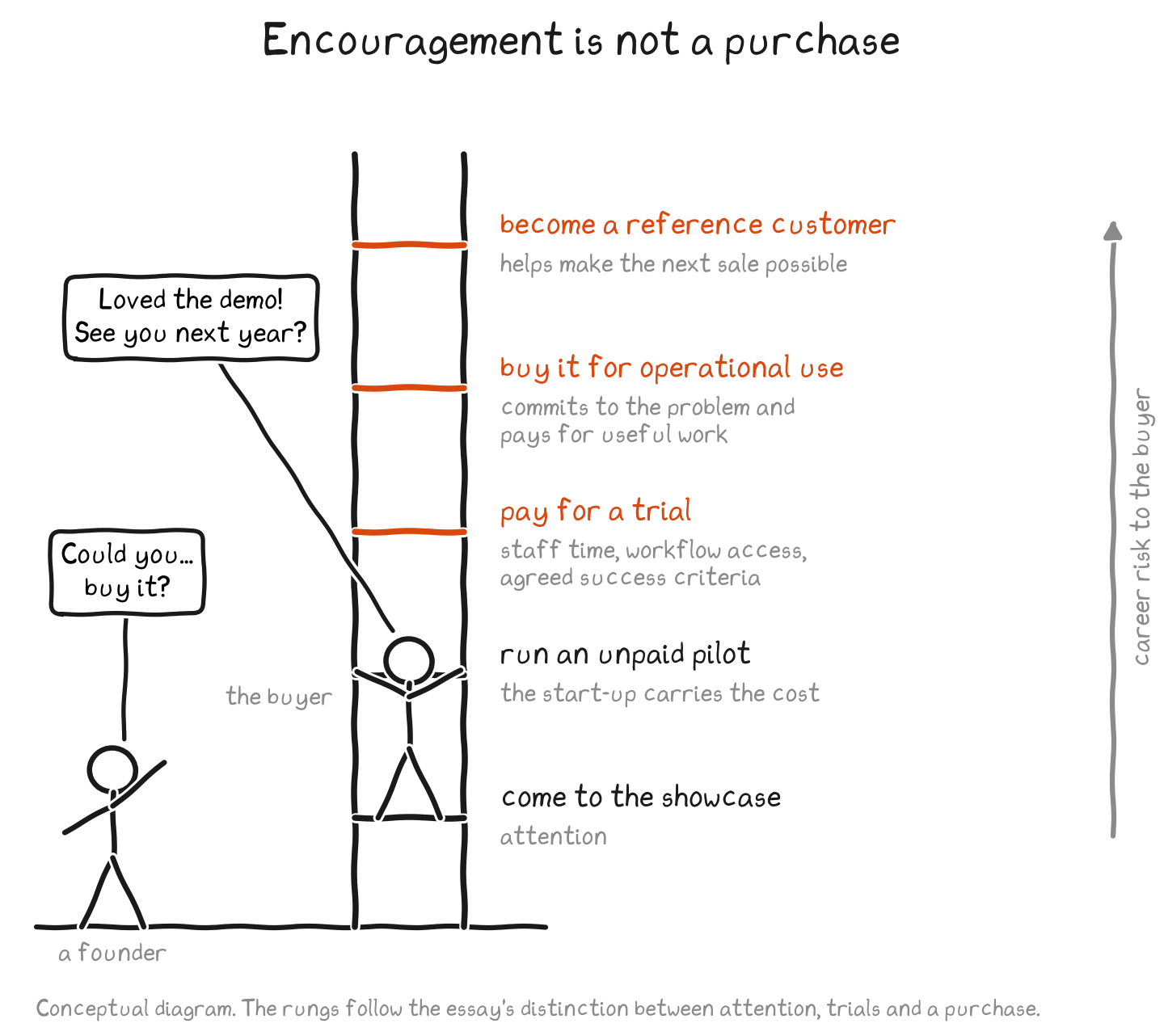
A meeting supplies attention. A customer commits to a problem and pays for useful work.
New entrants are also a practical remedy for the vendor lock-in Gallagher identified. They can only become alternatives if someone gives them a route into use. A reference-customer requirement can otherwise become circular: the company cannot win a customer without having one already.
The Business Research and Innovation Initiative, or BRII, gives this argument both support and a useful correction. It funded businesses to develop solutions to government challenges. Its independent evaluation reported that five of nine first-round proof-of-concept businesses had their product procured by the challenge agency. There was a route from development into purchase.[27]
The same evaluation found almost all agency staff managed challenges alongside their normal jobs. None of the successful round-three agency applications clearly identified the resources they would commit, despite a criterion asking for them. The evaluators recommended implementation budgets, dedicated staff and better handover. The supplier was being funded to develop a solution; the customer also needed capacity to adopt it.
The government's December 2025 response to a Senate inquiry confirmed BRII's closure to future rounds. Existing commitments would be honoured. The question is what replaces its route from an agency's problem to a potential purchase.[27:1]
The procurement records show a route from trial to purchase for established suppliers too. The Department of Veterans' Affairs' enterprise case-management trial was followed by a similarly named phase-one award to the same supplier: SFDC Australia, Salesforce's Australian entity. That is one case, and the department may have had sound reasons for its choice. It raises a worthwhile question about who can use the route, beyond whether the route exists.[28]
I cannot derive a defensible conversion rate for Australian product companies from the federal records. A grant, a panel place and an operational purchase are different events. An Australian contracting entity may be a reseller or a multinational subsidiary. A count of Australian supplier names will not tell us whether government is helping new Australian products find their first customers.
GovAI makes this customer role more complicated. Government can buy a product, develop an alternative and decide which external products can reach agencies through its platform. That resembles the familiar problem of a marketplace owner that also sells its own products. It is a reason to make access rules, costs and priority decisions visible, not an allegation that GovAI has already favoured itself.
Common infrastructure could make entry easier. A small Australian company might offer an application without rebuilding security and integration arrangements for every agency. Public components could lower costs for both public teams and suppliers. If every need instead becomes a request for the central team to build a feature, the same platform could remove a potential customer. Which happens is an empirical question.
The economic case needs the same discipline. In November 2024, TechnologyOne published an Insight Economics report arguing that ICT procurement creates effects beyond the price and immediate benefit to the buyer. Its framework covers competition, productive investment, skills and research, exports and resilience, alongside wider social and environmental effects.[29]
A product company can spread development costs and learning across customers. The report describes TechnologyOne developing audit-evidencing intellectual property through successive engagements, with government reference customers helping it enter the UK and New Zealand. Government can achieve useful reuse too, including through open-source components. The relevant comparison is actual reuse and retained knowledge, rather than a commercial or public label.[29:1]
Skills and research can outlast a contract. A purchase may let a company retain engineers, solve a difficult problem and develop reusable knowledge. An internal team may do the same. The additionality question is what would happen without the decision. Work a company would have funded anyway cannot all be credited to its government customer. Moving an engineer from another productive Australian team also has an opportunity cost.[29:2]
The same applies to infrastructure, exports and resilience. Infrastructure needs other useful users; exports need to be additional, with the costs of winning and serving customers counted. Either an Australian supplier or an APS product may depend on an overseas cloud or model. Country of incorporation is an incomplete measure of control. A recovery or model-substitution exercise would reveal more about sovereignty than another assurance about architecture. Social and environmental benefits need their own evidence too.
The weakest version of the domestic-procurement argument adds jobs, wages, tax, dividends and company value as if each were a separate gain. They are connected. Company value can already reflect expected profits; dividends distribute some of those profits. Tax matters to the budget, but transfers between Australian taxpayers and government are not automatically additional national wealth. Adding all these measures without adjustment counts parts of the same benefit more than once.
The report includes an anonymous stakeholder's recollection that a $1 million government purchase could generate $47 million of economic value through equity growth and debt. That is an interview quotation, not an estimated return from the study. Raising capital and borrowing money are financing events, not proof that Australia has become wealthier by those amounts.[29:3]
An argument for Australian capability should survive without that arithmetic. The report itself calls for additionality, warns against double counting, and does not favour an automatic Australian “Consider First” approach. It recognises competition risks and warns that a benefits calculator could encourage suppliers to raise prices to capture the apparent benefit.[29:4]
Government becoming a better customer for Australian capability is a proposition worth testing. It needs evidence of useful products, retained skills and further customers, alongside a service that meets its obligations. A lost sale for an Australian company is not, by itself, a loss for Australia.
Who pays for the next improvement?
Each customer relationship eventually reaches a budget decision. The public needs an improvement, an agency needs a change from its provider, or a supplier has a promising product ready for use. Someone has to pay for the next step.
At a Joint Committee of Public Accounts and Audit hearing on 2 February 2023, Daniel Mulino asked about agencies' incentives to innovate in procurement. Finance's Sabrena King described innovation awards and sharing successful case studies. Mulino clarified that he meant ongoing funding. Could an agency share in the gains it had achieved?
Finance deputy secretary Andrew Jaggers answered:
Generally, no.
He then explained that an agency could get better value and do more within an existing programme budget. But a one-off saving was different:
If it's a fortuitous save from a one-off big thing, that wouldn't necessarily stay with that department under the current rules.[30]
The qualification matters. Clearing a backlog or absorbing demand is valuable even when an agency's budget stays the same. A cash saving may produce a different calculation. The agency carries the cost, disruption and risk of changing the service. The Commonwealth may receive the saving without the agency retaining capacity to fund its next improvement.
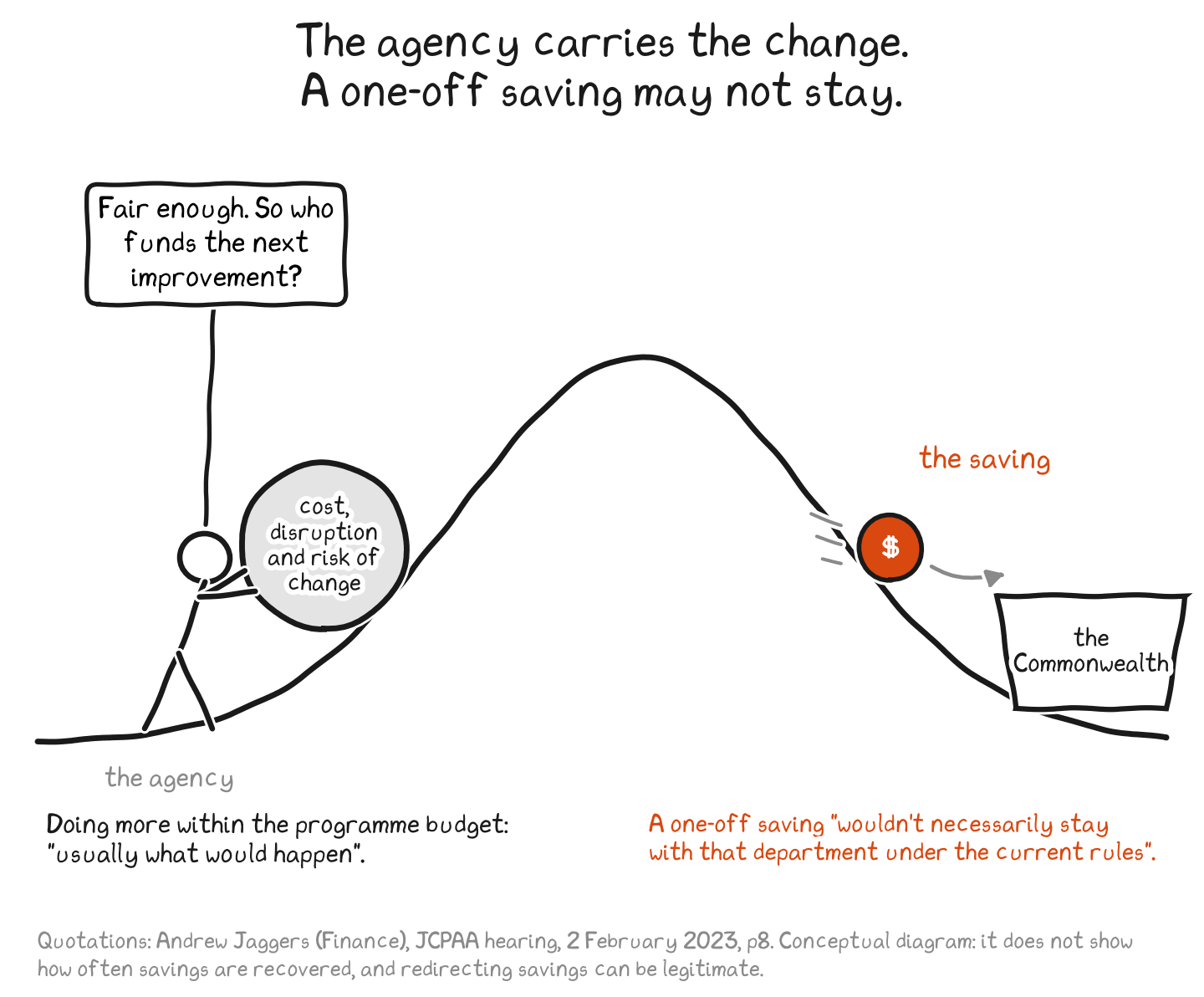
The agency carries the cost of change. Under the rules described in 2023, a one-off saving might not stay with it.
There is a legitimate reason for Finance to redirect savings to other public needs. Letting agencies retain every saving indefinitely could reward inflated baselines and protect work that is no longer a priority. What matters is whether the transition and continuing service obligations are funded, and whether the next useful improvement has a credible route to resources.
The hearing does not establish how often savings are recovered or how that affects decisions today. Those questions need business cases, allocation decisions and subsequent results. Accountability, professional judgement and public scrutiny also create reasons to improve. The financial arrangement is one part of the incentive system.
Culture becomes visible in those decisions. Can a team stop a release? Can it publish an inconvenient evaluation? Can it change the underlying process, or only the screen? Will the organisation fund a correction after the launch has delivered its announcement?
There is an economic reason to fund experiments that may fail. A small test buys information about whether a product or approach is suitable before a much larger commitment. That information has value when it changes what happens next. A trial that produces no operational product may still prevent a larger wasted investment. A cheap demonstration can be poor value if it leaves the important assumptions untouched.
That gives me a more specific objective than celebrating failure. Stopping a weak proposal early, explaining why and using the lesson in the next decision deserve recognition. Repeating a known mistake or exposing people to avoidable harm requires a different response.
Public scrutiny is a legitimate part of spending public money. A useful experiment needs an explanation that survives it: what was uncertain, why it mattered, what the test cost and which decision it informed. It needs limits on expenditure and exposure for people using the service. If unsuccessful tests damage a team's prospects of obtaining future resources, that may discourage useful testing. We should examine approval, stopping and subsequent funding decisions for evidence of that effect.
My prescription is to give a team a bounded service problem, access to users and an identifiable person who can change the relevant process. Fund discovery and operation as well as initial delivery. Compare feasible internal, shared and commercial approaches. Before a pilot begins, specify the assumption being tested, success and stopping criteria, and who will act on the answer.
Pay external participants for substantive trials on terms a small company can survive. Establish the route to an ordinary purchase before asking for repeated demonstrations. A successful pilot needs an adoption decision and operating resources; an unsuccessful one needs a recorded lesson and a reasoned stopping decision.
A central capability could help by supplying common infrastructure, engineering support and reusable evaluations, including approaches that failed. It should make useful learning easier to share, alongside useful software. Agencies still need room to test alternatives and evidence that a result applies in their circumstances.
AI can make an existing process faster. It can also make it cheaper to preserve a bad process by giving it a more accommodating interface. The technology cannot authorise a delegation, resolve a policy disagreement or give a team permission to stop collecting unnecessary information. Innovation theatre is a risk when technological movement becomes the visible result while the decisions controlling the service remain much the same.
What would change my mind
The concern about government becoming an inward-facing product provider is a hypothesis. So is the claim that buying Australian products will create worthwhile wider benefits. My working rule should face evidence capable of changing it.
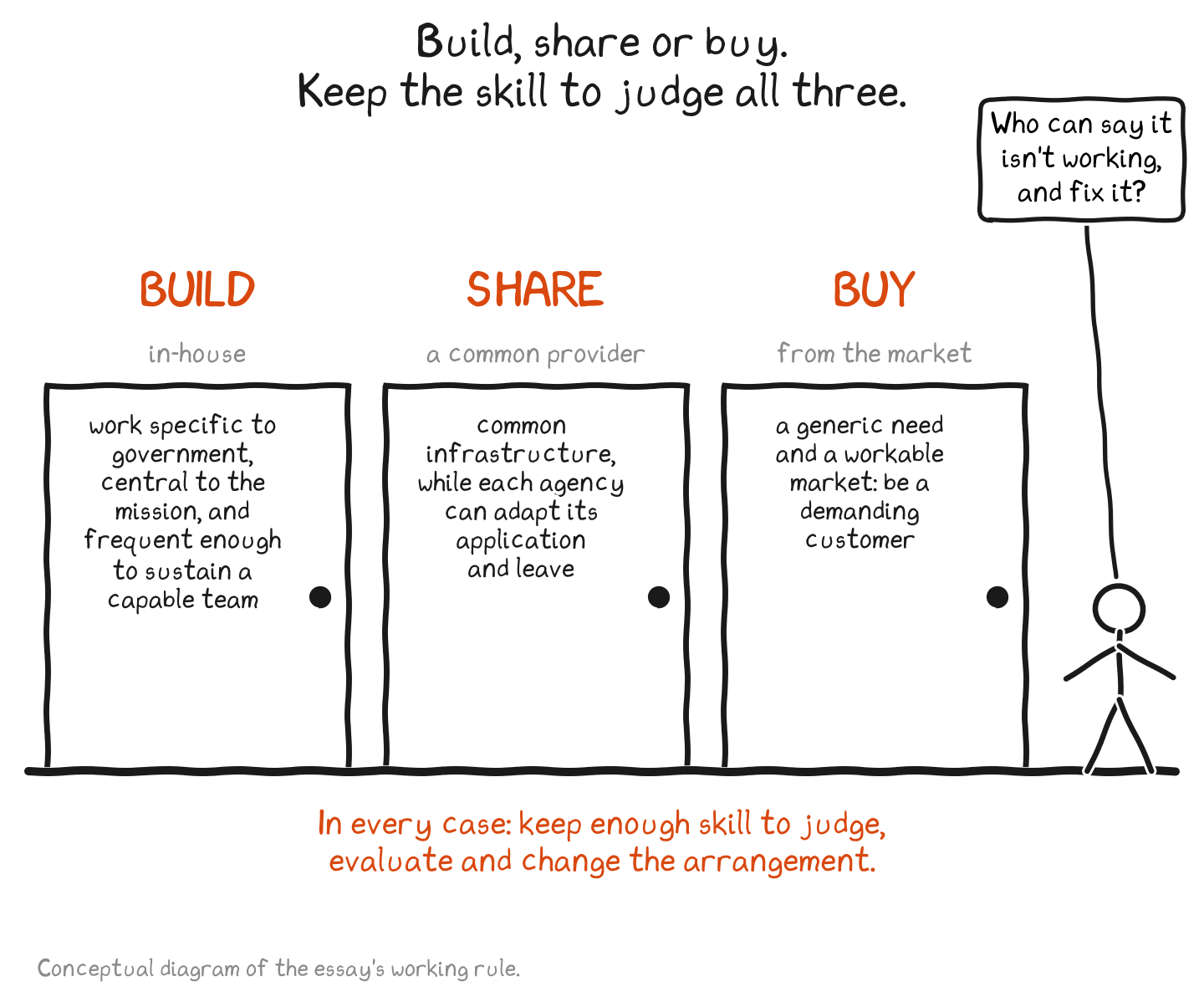
Build, share or buy, and in every case keep enough skill to judge, evaluate and change the arrangement.
I would follow a published sample of internal builds, shared services and commercial purchases. Select the cases before looking at outcomes. Record the alternatives and baseline, account for differences in complexity and users, and follow operation long enough to observe costs and corrections. Capability and subsequent sales need a longer window than a launch evaluation.
These are the results I would look for:
1. The public receives a better service
Supports the concern: Adoption or output rises while reliability, completion, access or relevant safety measures fail to improve.
Weakens the concern: People complete the intended task more reliably and promptly against a baseline, with quality and equity effects reported.
2. The agency can get a change made
Supports the concern: Important needs repeatedly wait without a reasoned decision; adapting or leaving requires extensive rebuilding.
Weakens the concern: User problems lead to decisions and delivered changes; agencies demonstrate adaptation, escalation and workable alternatives.
3. Australian products gain real customers
Supports the concern: Grants and unpaid pilots multiply while external applications stall at approval or renewal.
Weakens the concern: Independent Australian products enter paid operational use and find further customers; evidence identifies the additional capability created.
4. The whole-of-life economics hold
Supports the concern: Coding savings coexist with excluded support, integration and replacement costs, or an unfunded transition.
Weakens the concern: Comparable services sustain better outcomes at a competitive total cost, including staff time; resources follow explicit decisions.
5. Capability and learning survive
Supports the concern: Another team cannot operate the product; failed evaluations change neither investment nor process.
Weakens the concern: A different team changes or recovers it; tests produce reasoned stopping decisions, and later teams use the findings.
An APS team that delivers a better service, transfers knowledge and lowers the cost of useful external products would weaken my concern. An Australian supplier that wins a contract but creates no additional capability and leaves an expensive dependency would weaken my preferred industrial argument. Both belong in the test.
Turner's answer at the showcase left room for public teams, shared provision and companies like his. I think that was the right place to start. The choice becomes meaningful when we ask who can act on evidence that the arrangement needs to change.
For the public, that means someone responsible for improving the whole service. For an agency, it means influence over a provider's priorities and a workable alternative. For an Australian supplier, it means a customer willing to commit when the product meets a real need. These relationships can support one another if government makes their tensions explicit.
AI lowers the cost of beginning. Building sovereign capability means retaining the people, knowledge and choices to meet the cost of owning. I would like the APS to use the opportunity to do both, while helping an Australian industry develop the ability to improve those services further.
The final test belongs to the family, taxpayer or business dealing with government: has the service become easier and more reliable, and can we keep making it better?
Sources
Author's first-hand account of the afternoon panel Q&A at the AI Government Showcase, Canberra, 11 November 2026, checked against the author's automatic transcript. The public event page establishes the event's date and venue; the programme provides session context. The question quoted was mine. David Turner, Principal at Empirical Legal, presented Lext Australia; his answer is paraphrased because the automatic transcript is imperfect. Attribution and the account of his answer are based on the author's attendance. The programme is not a transcript of the exchange. ↩︎
Katy Gallagher, AI Government Showcase 2026, speech, 11 November 2026. Relevant passages describe GovAI Chat's September beta access, GovAI Exchange and hosting, training, barriers to adoption, Australian suppliers and the ambition for agency reuse. In the discussion of legacy systems and procurement, Gallagher explicitly identifies vendor lock-in as a problem. The article's comparison of delivery arrangements is the author's analysis. ↩︎ ↩︎ ↩︎ ↩︎
Lext Australia, LawAccess leverages purpose-built AI to improve customer and employee experience, customer story, read 14 November 2026. It describes a tool using LawAccess NSW's own resources to generate cited responses for information officers. Lext's website describes its legal-software and tailored-development work. This is the supplier's description of a NSW service, not a Commonwealth project or an independent outcome evaluation. The article does not adopt the page's accuracy, call-time or query-volume figures. ↩︎
Cui, Demirer, Jaffe, Musolff, Peng and Salz, The Effects of Generative AI on High-Skilled Work: Evidence from Three Field Experiments with Software Developers, June 2025. The official abstract reports 4,867 developers and a pooled 26.08 per cent increase in completed tasks, standard error 10.3 percentage points. The assistant provided code completions. ↩︎
METR, We are Changing our Developer Productivity Experiment Design, 24 February 2026. The update covers 57 developers, 143 repositories and more than 800 tasks, and identifies selection and measurement problems. METR's original July 2025 study now explicitly labels its historical result out of date. Neither study estimates APS whole-of-life product costs. ↩︎
Steering Committee for the Review of Government Service Provision, Report on Government Services 2026, Part A: Overview and Approach to performance measurement, Productivity Commission, 29 January 2026. Printed p4 explains comparative reporting, incentives and use in policy, evaluation and budgeting; pp4–6 describe coverage and exclusions; pp7–10 distinguish efficiency, outcomes, equity and quality. P8 says the report has no explicit cost-effectiveness indicators: combinations of efficiency, effectiveness and outcome indicators provide implicit reporting. See the 2026 data catalogue for service tables, observation periods and subsequent updates. RoGS is a service-performance source, not an evaluation of GovAI or a complete account of APS functions. ↩︎
Steve Blank, Lean LaunchPad – The Next Generation, 30 September 2026, updated 2 October. The quotation is the opening of the course-redesign discussion. Later passages describe a design partner committing staff time, data, integration effort, permissions, test environments and workflow changes. Blank explicitly calls the proposed syllabus a hypothesis to be tested. This is his teaching judgement, not an experimental estimate of AI's effects. ↩︎
Author's analysis of ATO Gazette advertisements and AusTender contract notices. The advertisements are Data Scientist, vacancy 10674875, 6 May 2016, and Senior Technical Analyst, 10522819, 9 April 2011. Their descriptions respectively name JMP, R and SAS together, and Python among programming skills. The analysis establishes advertised skill requirements across time, not installed software shares.
The contract is CN4073573, Provision of Software Licences or Subscriptions, ATO with SAS Institute Australia Pty Limited, ABN 13002287247. The original notice, published 2 July 2024, records $3,428,729.70. Amendment CN4073573-A1, published 4 June 2026, adds $54,743.70 in the consolidated extract. Adding the two produces $3,483,473.40. The recorded term is 21 June 2024–29 June 2027; the procurement method is limited tender. This is a licensing commitment, not expenditure or proof of particular workloads, user numbers or the status of any migration. ↩︎
Australian Taxation Office, Submission to the Inquiry into the use and governance of artificial intelligence systems by public sector entities, Joint Committee of Public Accounts and Audit, submission 18, 25 October 2024, p5, paragraphs 22–23, under Developing and maintaining AI capability in the ATO. These paragraphs describe the specialist data-science hub, in-house development, pretrained models, open-source packages and retained source code. The staff count and development approach are the ATO's account. ↩︎
ANAO, Governance of Artificial Intelligence at the Australian Taxation Office, Auditor-General Report 26, 2024–25, published 24 February 2025; summary conclusions and monitoring/evaluation findings. The 43-model count is at May 2024; the sampled-model finding concerns models built and deployed July 2023–May 2024. Current remediation has not been established by the audit-era evidence. ↩︎ ↩︎
Author's analysis of APS employment advertisements, federal procurement notices and Australian Government Directory observations, completed 12 November 2026. The Gazette extract contains 154,331 unique vacancy identifiers, dated 8 January 2010–1 October 2026. Duties were searched where available, with descriptions used otherwise; selected passages were manually checked. Advertisements establish recruitment intentions, not appointments, and some advertisers are outside the APS. Changes in source fields prevent a clean long-run comparison of capability. Automated responsibility categories are not used here as population estimates.
The procurement extract contains 885,864 AusTender notices, consolidated by AwardedTenders, a product of my company, covering 1 July 2016–5 November 2026. It contains 637,701 distinct base contract identifiers. Searches used agency, supplier and contract-description text. Originals and amendments were grouped by base identifier, and original values plus amendment changes were summed to calculate recorded commitments. These are nominal Australian-dollar commitments, not cash expenditure. Histories beginning before July 2024 have incomplete reduction reporting, and product-name searches do not establish complete programme budgets. The directory observations cover 9 January 2024–30 March 2026. These three sources describe different periods and cannot establish which delivery arrangement causes better services. ↩︎
Author's analysis of Australian Public Service Gazette vacancy text. Selected records: ATO, DevOps Engineer, vacancy 0772168, 3 September 2026; Services Australia, AI Cloud Engineer, 0772710, 17 September 2026; DVA, Senior Cloud Data Engineer, 0769287, 14 May 2026; DEWR, EL1 Software Developer, 0721939, and Business Analyst, 0721957, both 16 April 2023; and DEWR, Release Lead, 0721109, 2 April 2023. I examined descriptions and duties for explicit responsibilities covering maintenance, releases, testing, metadata, operational support and retirement. The DEWR notices explicitly identify the Apprenticeships Data Management System. These examples show advertised responsibilities, not filled roles, actual authority or successful delivery. ↩︎
Author's analysis of ADMS recruitment and AusTender notices. DEWR's advertisements are EL1 Software Developer, vacancy 0721939, 16 April 2023; Release Lead, 0721109, 2 April 2023; and Business Analyst, 0721957, 16 April 2023. Their descriptions explicitly identify ADMS and development, release or product-team responsibilities.
CN3744509, with APIS Group Pty Limited, is described as Provide Project Management Office (PMO) services for the Apprenticeships Data Management System (ADMS) project. Published 22 January 2021, it records an original $550,000 and four amendments, producing a recorded commitment of $3,367,866, with a term of 21 December 2020–31 December 2022. CN3941669, with KPMG, is described as DM-16010 -Apprenticeships Data Management System Project. Published 23 January 2023, it records $545,927.36 plus a $490,000 amendment, producing $1,035,927.36, with a term of 22 December 2022–30 November 2024. The analysis linked notices that explicitly named ADMS, grouped amendments under each original contract, and compared those external services with the advertised government responsibilities. Historical agency names are normalised in the extract, and pre-July-2024 reductions may be incomplete. These records demonstrate a mixed arrangement, not a complete programme budget, expenditure total or proof of retained technical control. ↩︎
Author's analysis of Australian Government Directory role, organisation and recorded-holder histories, 9 January 2024–30 March 2026. I followed technical functions across observations and checked changed role identifiers and acting-status records before treating them as possible departures. The ATO's Smarter Data Program Assistant Commissioner listing retained one recorded holder across the window while the Deputy Commissioner listing changed. DEWR's Digital Projects listing changed role and organisation identifiers between 11 July and 12 August 2025 while retaining the same recorded holder, title and function text. Services Australia's Digital Operations listing had three tenure rows but one recorded holder; the middle row represented an acting-status period. These cases show why row counts cannot measure departures. They do not establish unchanged delegations, retained team capability or service performance. ↩︎
Department of Finance, Australian Public Service Data Maturity Report 2024, published March 2025, pp1–3. Self-assessments were conducted May–July 2024. The report cautions against treating the maturity scale as a universal requirement or ignoring variation within agencies. The reported mean is 2.02 out of five; 21 per cent had not appointed the appropriate senior data leader. Reported median scores range from 1.47 for micro agencies to 2.17 for extra-large agencies. Developing maturity may suit some agencies, and organisation-wide scores may conceal stronger teams. ↩︎
Felix Barbalet, Deja Vu: Why the APS struggles with data maturity, 14 April 2025; The All-Singing, All-Dancing Central Team, 29 November 2025; and Familiarity is the enemy, 24 April 2026. These are callbacks to my earlier arguments, not independent evidence for them. Deja Vu correctly described the system-wide score as two out of five; the present essay narrows the institutional judgement in light of the report's qualifications and evidence of functioning technical teams. ↩︎ ↩︎ ↩︎
Senate Finance and Public Administration Legislation Committee, Estimates, 28 May 2026, official Hansard, p60, Chris Fechner. The second quotation ends before the continuation explaining accountable officials and transparency statements. See also the discussion of larger-agency capability on p59. ↩︎
Joint Committee of Public Accounts and Audit, Public hearing, 24 April 2024, official Hansard, p4, Adam Shain, discussing Workforce Australia. Other passages address AAMS and ADMS, including retained architecture and project capability; the quoted usability criticism should not be attributed to ADMS. ↩︎
Author's account of AI in Practice: lessons from GovAI, AI Government Showcase, 11 November 2026, 1:30 pm. The public programme lists Daniel Livesey, Director GovAI, and Andrew Morrison, Assistant Secretary GovAI. In the Q&A, the response to a question about using GovAI Chat alongside Copilot discussed work beyond Microsoft's ecosystem, different models' strengths and control over feature priorities. The article paraphrases that answer from the author's automatic transcript and attendance. It does not assign it to either presenter; the programme alone cannot establish who answered or verify the wording. The comparison with IPEA's position is the author's analysis. ↩︎
Senate Finance and Public Administration Legislation Committee, Estimates, 26 May 2026, official Hansard, pp95–96, Christina Grant; p88, Simon Newnham. Grant describes the project-board seat, requirements team, improvement lead-in, satisfied users and budget constraints. ↩︎
Senate Finance and Public Administration Legislation Committee, Estimates, 26 October 2026, uncorrected proof Hansard, p121, Simon Newnham. The claim concerns the specific cessation/recommencement change; a completion date was requested on notice. ↩︎
Senate Finance and Public Administration Legislation Committee, Estimates, 30 May 2024, official Hansard, p86, Jenny Wilkinson. The quotation is an extract from a longer sentence reporting the late-2023 decision. ↩︎
Steve Blank, The Secret History of Silicon Valley Part VIII: The Rise of Entrepreneurship, 6 August 2009, describes military contracts supporting early Stanford electronics spin-outs; see also the series index. Daniel P. Gross and Bhaven N. Sampat, America, Jump-Started: World War II R&D and the Takeoff of the US Innovation System, American Economic Review 113(12), December 2023, pp3323–3356. The published abstract reports effects on technology clusters, entrepreneurship and employment persisting at least into the 1970s. This historical R&D evidence does not isolate first-customer procurement from research support or establish a return for current Australian contracts. ↩︎
Engineering and Technology History Wiki, Integrated Circuits and the Space Program and Missile Defense, read 14 November 2026, opening discussion of early integrated circuits and Apollo demand. It reports prices of about US$1,000 in 1960 and US$25 by 1963, attributing the fall to demand from Apollo. These are the overview's historical nominal-dollar figures, not a controlled causal estimate or a forecast of savings from APS software procurement. ↩︎
Sabrina T. Howell, Financing Innovation: Evidence from R&D Grants, American Economic Review 107(4), April 2017, pp1136–1164. The study uses ranked applicants to US Department of Energy SBIR awards in a quasi-experimental evaluation. Its abstract reports an approximate doubling of the probability of subsequent venture capital, alongside patenting and revenue effects. It says certification likely does not explain the grant effect, and identifies technology prototyping as the mechanism. It studies grants, not an Australian procurement programme or the relative performance of internal development. ↩︎
Author's account of Canberra's Innovation Showcase, hosted by CBRIN on 4 November 2026. The public showcase page identifies the event, workshop and debate. The procurement remark is reported from my recollection of the debate, without quotation marks, rather than from a verified transcript. I ran the AI workshop with the AI CoLab. The account concerns the panellist's experience and is not an estimate of procurement barriers across firms. ↩︎
Nous Group, Business Research and Innovation Initiative Impact Evaluation, dated 31 August 2021, published by DISR on 30 May 2023. Printed p7 reports procurement by the challenge agency for five of nine first-round proof-of-concept businesses; p77 describes agency workloads and resource commitments; pp81–84 recommend commercialisation support, implementation resources, handover and better monitoring. These are historical evaluation findings, not a statement about every participating agency or current arrangements. The Australian Government's response to the Senate inquiry into sovereign technology capability, dated December 2025 and tabled 26 February 2026, PDF p6, confirms closure to future rounds and says existing rounds and commitments would be honoured. It attributes the decision to the 2024–25 MYEFO. This establishes the decision, not a finding that poor programme performance caused it. ↩︎ ↩︎
Author's analysis of DVA AusTender notices. CN4046438, Enterprise Case Management Trial, was published on 15 April 2024, with an original value of $445,159 and a recorded term of 31 March–30 June 2024. CN4156410, Entreprise Case Management Solution - Phase 1 (spelling as recorded), has a value of $3,211,056.13 and a recorded term of 21 May 2025–13 October 2026. Both identify SFDC Australia Pty Limited, Salesforce's Australian entity, ABN 91109182989, as supplier. I searched for pilot, trial and prototype descriptions, then checked later original awards at the same agency against the supplier ABN. Matching the descriptions as well as the ABN supports a related trial-to-phase sequence. It does not establish evaluation success, Australian IP, or a general pilot-to-product conversion rate. Values are recorded commitments, not expenditure. ↩︎
Insight Economics, Improving evaluation of economic impact in ICT procurement, final report commissioned by TechnologyOne, cover dated 17 October 2024. See pp35–40 for the framework; pp38 and 42–43 for additionality; p47 for TechnologyOne's audit-evidencing example and claimed export opportunity; p48 for skill formation; pp49–54 for research and knowledge spillovers; p52 for the anonymous $47 million recollection; p55 for double counting; and pp61–67 for procurement options, competition risks, possible price responses and implementation. The valuation claim is an interview quotation, not a modelled return. The export example is the commissioning company's account, not an independent causal estimate. The review supplies a framework, not procurement-specific spillover coefficients. Page references use printed page numbers. TechnologyOne's Industry leaders call for more robust ICT procurement practices in Australia, 13 November 2024, announces the report.
I am listed among interviewed stakeholders on p69. I co-founded Psithur, which supported the report's public release. ↩︎ ↩︎ ↩︎ ↩︎ ↩︎
Joint Committee of Public Accounts and Audit, Commonwealth procurement, public hearing, 2 February 2023, Official Hansard, p8. Daniel Mulino asks about financial incentives and future funding after innovative procurement; Sabrena King describes awards and knowledge-sharing; Andrew Jaggers distinguishes doing more within a programme budget from retaining a one-off saving. His initial “Generally, no” is qualified in the same exchange. This is a JCPAA inquiry hearing, not Senate Estimates, and it does not establish a universal or current rule for recovering savings. ↩︎